Key figures
| Figure | Why it matters |
|---|---|
| $0 | Current product revenue |
| $3.7bn | Approximate recent equity market value |
| $502m | Cash and investments at the end of June 2026 |
| $3.6bn | Illustrative base case risk adjusted equity value |
| $0.7bn to $8.1bn | Range across the illustrative bear base and bull cases |
There is something counterintuitive about Viking Therapeutics. The company has never generated a dollar of revenue. It has no approved medicine. It is loss making. During the first six months of 2026 alone, it spent approximately $266 million on research and development and recorded a net loss of $286 million. At the end of June, it had around $502 million of cash and investments.
And yet investors currently value the company at roughly $3.7 billion. Viking's shares most recently closed at around $31.98. With approximately 116.7 million shares outstanding at the last reported count, that implies an equity valuation approaching $3.7 billion. So what exactly are investors buying? Not earnings. There aren't any. Not cash flow. It is negative. Not an established commercial franchise.
There isn't one yet. Investors are effectively paying billions of dollars for a probability. The probability that an experimental obesity medicine called VK2735 successfully completes Phase III trials. The probability that regulators approve it. The probability that doctors prescribe it. The probability that patients stay on it. The probability that it can compete in one of the most commercially attractive, and increasingly competitive, markets in global pharmaceuticals.
And ultimately, the probability that a molecule that today generates precisely zero dollars of revenue might one day generate several billion dollars every year. That makes Viking Therapeutics a perfect case study for one of the most important techniques in biotechnology finance:
risk adjusted net present value, or rNPV.
It is also a useful reminder that in biotechnology, sometimes the most valuable asset on the balance sheet is not a factory, a patent or even a drug. It is uncertainty moving in your favour.
A company with no revenue can still be worth billions
If we were valuing GSK, we could begin with revenues, profits and free cash flow. If we were valuing Madrigal Pharmaceuticals, we could begin with the number of patients already taking Rezdiffra and then model how quickly that commercial franchise might expand. Viking provides much less current financial information to work with. Its income statement tells us surprisingly little about its economic value.
Revenue:
$0.
Research and development expense for the first six months of 2026:
$265.9 million.
Net loss:
$286.3 million.
Accumulated deficit: more than $1.1 billion. Traditional earnings measures cannot tell us much about Viking at this stage. There is no meaningful P/E ratio because there are no earnings. Price to sales is equally useless because there are no sales. Even book value tells us very little. A successful obesity drug could eventually be worth many multiples of the company's accounting assets. A failed Phase III programme could make much of today's market valuation disappear.
This is why biotechnology requires a different mentality. We have to value not what the company earns today, but what it might earn tomorrow, multiplied by the probability that tomorrow actually happens.
The molecule at the centre of the valuation
VK2735 is a dual agonist targeting the GLP 1 and GIP receptors. That should sound familiar. The enormous success of modern obesity medicines has demonstrated that manipulating these metabolic pathways can produce clinically meaningful weight loss and, importantly for investors, create extraordinarily valuable pharmaceutical franchises. Viking's injectable VK2735 produced striking Phase II results. After only 13 weeks, patients receiving the highest evaluated dose achieved mean weight loss of approximately 14.7% from baseline, compared with approximately 1.7% for placebo. Weight loss had not plateaued by week 13, while up to 88% of patients in treatment groups achieved at least 10% weight loss.
That matters because obesity treatment is not a niche pharmaceutical market. A medicine capable of obtaining even a modest share of a global obesity market measured in tens of billions of dollars can itself become a multibillion dollar product. But Viking has something else. It is also developing an oral formulation of VK2735. In its Phase II oral study, patients taking the tablet achieved mean weight loss of up to approximately 12.2% after 13 weeks, again without an apparent plateau at the end of the treatment period.
So Viking is potentially holding two commercially interesting versions of the same molecule: a weekly injectable, and a daily tablet. The injectable is already in Phase III. The oral programme is expected to begin Phase III development in the fourth quarter of 2026. And that is where the valuation begins.
Phase III changes the mathematics
Viking's two pivotal injectable Phase III trials are called VANQUISH 1 and VANQUISH 2. Both are now fully enrolled, and Viking expects the studies to progress through 2027. At first sight, this sounds like a scientific milestone. For an investor, however, Phase III is also a financial milestone. Imagine a hypothetical drug that would be worth $10 billion if approval were guaranteed.
At an early preclinical stage, perhaps the probability that it ultimately reaches the market is very small. Its risk adjusted value might therefore be only a fraction of that $10 billion. Then it succeeds in Phase I. The probability rises. It succeeds in Phase II. The probability rises again. Phase III succeeds. The probability rises dramatically. Regulators approve it. Much of the clinical uncertainty disappears.
Notice what has happened. The eventual sales opportunity may not have changed at all. The potential drug might always have been capable of producing $10 billion of value. What changed was the probability that investors would ever receive those cash flows. That means every successful clinical milestone effectively releases another portion of the drug's latent value. Biotechnology investing is therefore partly the business of buying probabilities before they become certainties.
The basic rNPV equation
The concept is simpler than the terminology suggests. Suppose a drug could generate future cash flows worth $10 billion today if approval were certain. But there is only a 50% probability that the drug successfully reaches the market. A very simplified risk adjusted value would begin with:
$10bn × 50% = $5bn.
We then subtract the present value of the money still required to finish development and commercialise the drug. Then we add the company's existing cash. In simplified form:
rNPV = probability adjusted future cash flows minus remaining development costs + net cash
That is the framework I will use for Viking. The numbers that follow are deliberately illustrative. They are not Viking management forecasts and they are not investment recommendations. The purpose is more interesting:
What assumptions would need to be true for today's $3.7 billion valuation to make financial sense?
Step 1 What could VK2735 eventually sell
This is simultaneously the most important and most dangerous assumption. You could construct an enormous valuation simply by declaring that VK2735 becomes a $20 billion blockbuster. That would produce a large number without showing why the assumption is credible. Instead, we need to ask what a plausible mature franchise might look like. For my base case, I assume the injectable programme obtains regulatory approval and begins meaningful commercialisation around 2029.
I then build the following illustrative revenue curve:
| Year | Illustrative VK2735 revenue |
|---|---|
| 2026 | $0 |
| 2027 | $0 |
| 2028 | $0 |
| 2029 | $0.5bn |
| 2030 | $1.5bn |
| 2031 | $3.0bn |
| 2032 | $5.0bn |
| 2033 | $6.5bn |
| 2034 | $7.5bn |
| 2035 | $8.0bn |
| 2036 | $8.5bn |
| 2037 | $8.5bn |
I then assume sales gradually decline thereafter as competition intensifies and the franchise moves towards the later years of its intellectual property protection. Viking's 2025 annual filing indicates that the patent portfolio covering its GLP 1 agonist programmes includes patents and applications with nominal terms extending into approximately 2042 to 2045, although actual commercial exclusivity will depend on which claims ultimately apply and survive.
An $8.5 billion peak sales assumption is unquestionably ambitious. But it is not the same as assuming Viking dominates obesity. In a sufficiently large market, an $8 billion drug can still represent only a fraction of total treated patients. And importantly, this model initially values primarily the injectable VK2735 franchise. The oral version creates additional optionality that we can consider separately.
Step 2 Revenue is not value
Suppose VK2735 eventually generates $8 billion annually. Viking does not get to keep $8 billion. Manufacturing costs must be paid. Sales representatives must be employed. Rebates and discounts affect realised pricing. Post marketing studies continue. New trials have to be funded. Corporate expenses remain. Taxes exist. So we have to move from revenue towards free cash flow. For my simplified model, I assume VK2735 initially produces limited cash as Viking builds its commercial infrastructure, before mature free cash flow margins gradually approach approximately 30 to 32%.
That means an $8.5 billion mature franchise might eventually produce something in the region of:
$2.5 to $2.7 billion of annual free cash flow.
Now we have something that can actually be valued.
Step 3 Money received in 2036 is worth less than money received today
Suppose Viking generates $2.5 billion of free cash flow in 2036. You cannot simply add $2.5 billion to today's valuation. A dollar received ten years from now is worth less than a dollar received today. Investors therefore discount future cash flows. For the base case I use a relatively high 12% discount rate. Why so high? Because this is not a regulated utility with predictable cash flows.
Viking faces: clinical risk, regulatory risk, commercial risk, competitive risk, manufacturing risk, pricing risk, and financing risk. Higher uncertainty demands a higher required return. When I discount the positive cash flows from this hypothetical VK2735 franchise back to today, their present value is approximately:
$7.2 billion
if approval and commercial success were guaranteed. That is the un risked value of the future positive cash flows in this simplified model. But approval is not guaranteed. So we now introduce the most important variable.
Step 4 Probability of success
For my base case, I use an illustrative 60% combined probability that the current late stage injectable programme ultimately produces an approved commercially viable product. That is not a claim that Viking's precise scientific probability is objectively 60%. It is a modelling assumption. And it can be changed. So:
$7.2bn × 60%
gives approximately:
$4.34 billion
of probability adjusted future positive cash flows. Immediately we can see why biotechnology valuations behave so dramatically. Change the probability from 60% to 40% and approximately $1.45 billion disappears. Change it from 60% to 80% and approximately $1.45 billion appears. Nothing has happened to peak sales. Nothing has happened to pricing. Nothing has happened to margins. Only the assumed probability changed.
Step 5 Science still needs to be paid for
There is another mistake investors can make. We cannot probability adjust the future upside while pretending development is free. Viking is spending heavily. R&D expense rose to approximately $115.8 million in Q2 2026 alone, compared with $60.2 million in the comparable period a year earlier. During the first six months of 2026, R&D expenditure reached roughly $266 million. The company is running large late stage trials, preparing the oral programme for Phase III, developing manufacturing capacity and advancing additional metabolic assets.
My simplified model assumes around:
$400 million of relevant spending in 2026
$500 million in 2027
$600 million in 2028
and additional launch investment thereafter. Discounted back to today, the negative pre commercial cash flows in the model have a present value of approximately:
$1.25 billion
These costs matter because a failed drug can lose its future revenues while still consuming much of the capital required to discover that it has failed. That asymmetry is central to biotechnology.
Put everything together
We can now assemble the base case. Present value of future positive VK2735 cash flows:
$7.24bn
Probability of success:
60%
Risk adjusted positive cash flows:
$4.34bn
Less present value of assumed development and pre commercial costs:
minus $1.25bn
Add Viking's approximately $502 million of cash and investments:
+$0.50bn
Estimated base case equity value:
≈ $3.6 billion
Using roughly 116.7 million shares, that corresponds to approximately:
$31 per share
Viking's latest share price? Approximately:
$31.98.
The comparison is revealing. Our deliberately simplified model lands remarkably close to the public market. Not because $31 is somehow the objectively correct value of Viking. It isn't. But because it tells us something much more useful about what the market may already be assuming. At roughly today's valuation, investors appear to be paying for something resembling: a successful late stage injectable programme,
several billion dollars of eventual peak sales, attractive mature margins, but with a substantial discount for the possibility that the entire commercial thesis does not materialise.
Scenario analysis
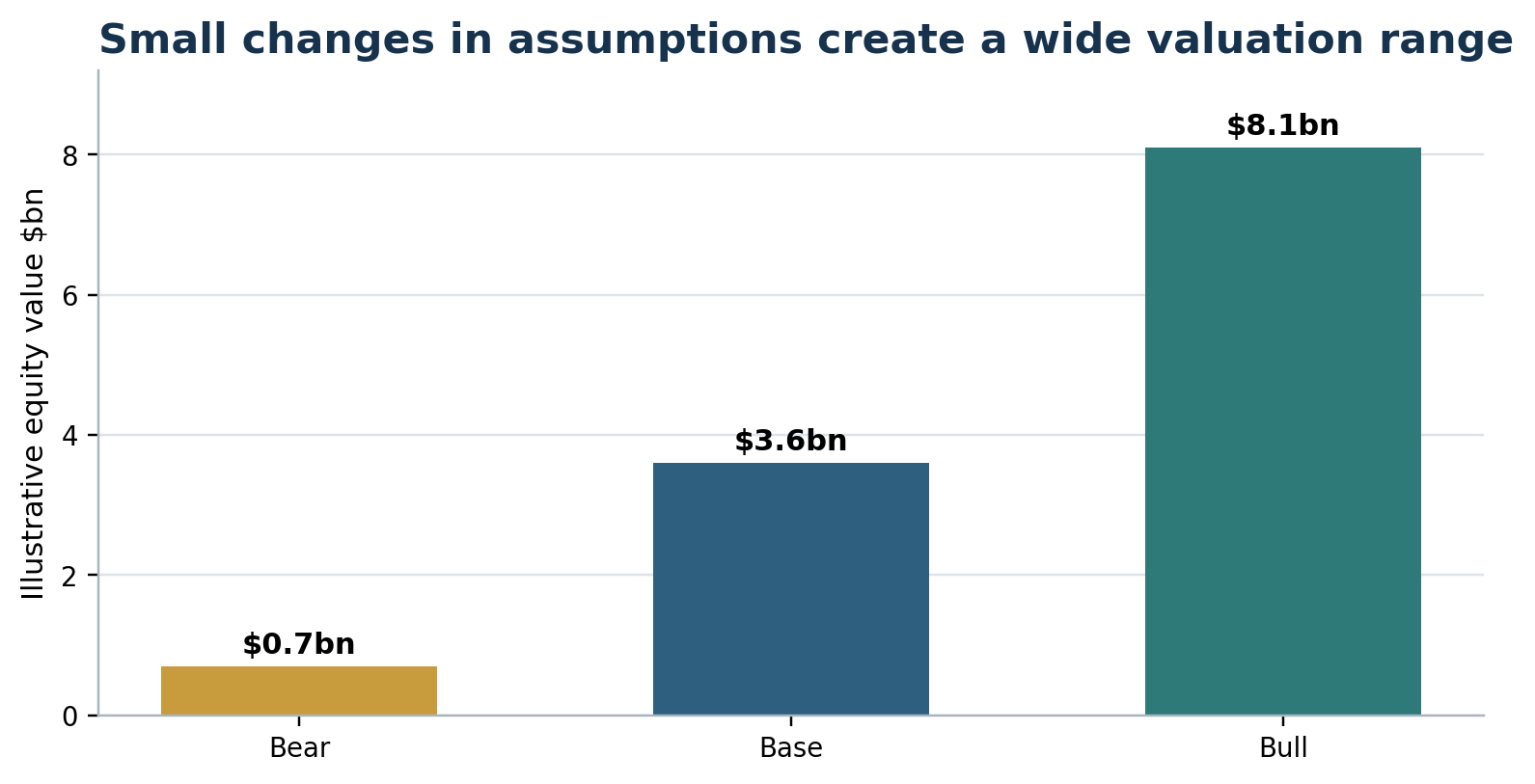
This is where the model becomes genuinely useful. Imagine three possible futures.
| Scenario | Peak sales | Probability of success | Discount rate | Approximate equity value |
|---|---|---|---|---|
| Bear | About $5bn | 40% | 14% | About $0.7bn |
| Base | About $8.5bn | 60% | 12% | About $3.6bn |
| Bull | About $12bn | 75% | 10.5% | About $8.1bn |
The range is enormous. Approximately $700 million to more than $8 billion. Yet all three valuations describe exactly the same company today. Same employees. Same molecule. Same laboratories. Same bank account. The difference is simply what we believe about its future. That is why asking whether a clinical stage biotech is “cheap” based only on its current market capitalisation is almost meaningless.
Cheap relative to what probability? Cheap relative to what peak sales? Cheap relative to what margin? Cheap relative to what competitive landscape? Cheap relative to what dilution? That is the real work.
The effect of trial failure
Suppose the pivotal Phase III trials fail. Our $7.2 billion of un risked future cash flows does not slowly decline. A large portion can disappear almost instantly. The company would still retain its cash, other pipeline assets and intellectual property. But the principal assumption underpinning today's valuation would have been fundamentally altered. This is why biotechnology companies can lose 50%, 60% or even more of their market value following a single clinical readout.
The market is not behaving irrationally. It is recalculating the probability weighted cash flows. If a $5 billion expected asset suddenly has a near zero probability of reaching market, its financial value does not decline gently because investors' feelings have changed. The asset itself has been economically impaired.
The effect of clinical success
Imagine VANQUISH 1 and VANQUISH 2 report compelling Phase III results. The efficacy looks competitive. Safety remains attractive. The FDA pathway becomes clearer. Our assumed probability of commercial success might rise from 60% to perhaps 85% or 90%. Return to the same $7.24 billion of discounted positive future cash flows. At a 60% probability:
$4.34bn.
At a 90% probability:
$6.52bn.
Nearly:
$2.2 billion of theoretical value has appeared.
No patient has yet bought the medicine. The company may still have zero product revenue. But clinical uncertainty has decreased. This is one of the most important concepts in biotechnology valuation:
De risking creates value.
A successful clinical trial can be economically similar to discovering billions of dollars of new assets.
The value of the oral formulation
So far, our model has deliberately avoided giving enormous credit to the oral formulation. This matters. Because if oral VK2735 also succeeds in Phase III, Viking may possess something much more valuable than one obesity drug. It could potentially possess a franchise. Some patients may prefer injections. Others may strongly prefer tablets. Some may begin treatment using an injectable and later transition to oral maintenance therapy.
Viking is already studying different maintenance regimens and has been exploring whether less frequent dosing could sustain weight loss after the initial treatment phase. The commercial implication is interesting. The oral formulation does not necessarily need to replace the injection. It could expand the number of ways in which the molecule is used. That introduces what investors often call optionality.
And optionality is one reason pipeline businesses can be worth more than a simple DCF of their lead indication.
Optionality is valuable precisely because it is uncertain
Imagine the injectable asset alone justifies $3.6 billion. Now consider additional possibilities: the oral formulation succeeds; maintenance dosing allows less frequent injections; VK2735 expands into additional metabolic indications; Viking's amylin programme VK3019 succeeds; another pipeline asset works; or a larger pharmaceutical company finds strategic value in owning the entire platform. Not all of these will happen. They should therefore not all be included at full value.
But they are not worth zero either. This is where sophisticated biotechnology valuation begins to resemble a collection of financial options. Each programme has: a potential future payoff, a cost required to continue, a probability of success, and a decision point at which management can invest more or stop. A failed Phase I programme can be abandoned. A successful Phase II programme attracts more capital.
A spectacular Phase III programme can trigger commercial investment, or an acquisition offer. R&D therefore behaves like a sequence of capital allocation options.
How a strategic buyer might value Viking
Now imagine Viking receives interest from a large pharmaceutical company. The strategic buyer does not ask:
Viking has never generated revenue, so why would we pay billions for it?
It asks:
What would VK2735 be worth inside our organisation?
That can produce a very different number. A large pharmaceutical company might already possess: global regulatory teams, commercial sales organisations, payer relationships, manufacturing infrastructure, distribution, medical affairs teams, and marketing operations. For Viking to become a global pharmaceutical company itself, many of those capabilities would need to be built. A strategic acquirer may already own them. This creates possible synergies. Suppose Viking's standalone risk adjusted value is $4 billion.
But a strategic acquirer believes it could generate: $2 billion of additional value from faster international expansion, $1 billion through avoided duplicated infrastructure, $1 billion from manufacturing advantages, and another $2 billion through better lifecycle management. The exact figures are hypothetical. The principle is not. Perhaps Viking is worth $4 billion independently but $8 billion inside the right owner. A buyer could therefore offer $6 billion.
Viking shareholders receive a substantial premium. The buyer still believes it has created $2 billion of value. This is why acquisitions cannot be evaluated only by looking at the target company's current earnings. Particularly in pharmaceuticals, the buyer may be purchasing future cash flows it believes it can develop more effectively than the existing owner can.
The timing of a possible acquisition
This question is often asked about promising biotechnology companies. Sometimes waiting has value. A pharmaceutical company could acquire Viking before Phase III results and potentially pay a lower price. But it would inherit more clinical risk. Alternatively, it could wait until Phase III succeeds. The asset would be substantially de risked. But Viking's valuation might rise dramatically, forcing the buyer to pay several billion dollars more.
This creates an interesting acquisition dilemma:
Buy uncertainty cheaply or buy certainty expensively.
The same principle appears throughout pharmaceutical M&A. The earlier you acquire a molecule, the cheaper it may be. But the probability that it fails is greater. The later you acquire it, the scientific uncertainty falls. But the price rises. That is why pharmaceutical business development is fundamentally a form of probability weighted capital allocation.
Cash runway and future financing
There is another variable that equity investors cannot ignore:
cash runway.
Viking had approximately $502 million of cash, cash equivalents and short term investments at the end of June 2026. Management stated that it expects its current resources to fund operations through at least 30 September 2027. That sounds reassuring. But Phase III programmes are expensive. Regulatory submissions are expensive. Manufacturing inventory is expensive. Launching a major obesity drug is extremely expensive.
If Viking intends to commercialise VK2735 independently, it could eventually require additional capital. That money might arrive through: debt, partnerships, licensing agreements, or additional equity issuance. And additional shares create dilution. Suppose Viking ultimately creates $5 billion of equity value. That sounds wonderful. But if the company must significantly increase its share count to finance the journey, each existing shareholder owns a smaller portion of that $5 billion.
Biotechnology investors therefore need to model not only:
Will the drug work?
but also:
How much capital will be consumed before shareholders reach the destination?
A successful drug can still be a poor investment
This is perhaps the most important point. Suppose VK2735 works. The FDA approves it. Doctors prescribe it. It becomes a $4 billion a year medicine. That sounds like an extraordinary success. But imagine investors had previously valued Viking at $15 billion based on assumptions that VK2735 would eventually generate $12 billion annually. The drug succeeded medically. The company succeeded commercially. The investment could still disappoint.
Why? Because the outcome was worse than the expectation already embedded in the share price. This is the difference between company analysis and investment analysis. Company analysis asks:
Is this a good drug?
Investment analysis asks:
Is this drug better or worse than what today's valuation already assumes?
Those are not the same question. And understanding that distinction is one of the most valuable lessons in finance.
Competition and peak sales
Our model has another vulnerability. Competition. A forecast showing VK2735 smoothly climbing towards $8 billion of revenue looks beautifully orderly in Excel. Reality will not be orderly. Other obesity treatments will continue improving. New mechanisms will emerge. Oral medicines may become increasingly important. Combination therapies may improve efficacy. Manufacturing capacity may expand. Payers will negotiate aggressively. Patients may switch products.
Pricing could decline. And doctors may favour competitors based on outcomes that do not yet exist today. This means the most dangerous cell in a biotechnology spreadsheet is often:
Peak Sales
It looks like a number. In reality it contains assumptions about: clinical efficacy, safety, patient preference, market size, market share, pricing, competitors, physician behaviour, insurance coverage, manufacturing, duration of treatment, and adherence. One spreadsheet cell can contain an entire industry.
Patent life and commercial value
Even if VK2735 becomes extraordinarily successful, the cash flows do not continue forever. Intellectual property gives pharmaceutical companies something close to temporary economic protection. Eventually that protection weakens. Viking reports GLP 1 related patents and applications with nominal terms extending into approximately 2042 to 2045. That gives a potentially long commercial runway if the asset succeeds. But the value of a patent is not simply the number of years printed on a document.
A patent matters only if: the drug reaches the market, the relevant claims remain enforceable, competitors cannot successfully design around them, and the medicine remains commercially relevant. Twenty years of patent life on a drug nobody wants is worthless. Ten years of protection on a $10 billion blockbuster can be extraordinarily valuable. Patent duration therefore multiplies commercial success. It cannot substitute for it.
What is Viking really worth
The most responsible answer is:
It depends.
That is not an evasion. It is the entire point of biotechnology valuation. In my simplified model: a disappointing $5 billion peak sales outcome combined with a 40% success probability can produce a valuation below $1 billion. A base case of roughly $8.5 billion of peak sales and 60% success produces a valuation of around $3.6 billion. A highly successful franchise reaching approximately $12 billion of peak sales, combined with substantial de risking, can support a value above $8 billion.
And these figures still do not fully credit every possible asset in Viking's pipeline. A traditional investor may dislike that degree of uncertainty. A specialist biotechnology investor may see precisely the opposite. The uncertainty is the opportunity.
What the valuation reveals
GSK taught us how to value an established pharmaceutical company. Its question was:
Can tomorrow's medicines replace the cash flows generated by yesterday's medicines?
Madrigal taught us how to value an emerging commercial pharmaceutical company. Its question was:
How large can one newly launched drug become?
Viking asks something even more fundamental:
What is a medicine worth before a single patient has ever paid for it?
The answer is not zero. But it is not its full potential value either. Its value sits somewhere between the two. And that gap is probability. A molecule capable of producing billions of dollars of future cash flow may exist today. But shareholders do not own those billions yet. First the trial must work. Then regulators must approve it. Then doctors must prescribe it.
Then payers must reimburse it. Then patients must stay on it. Then manufacturing must scale. Then competitors must be beaten. Only after passing through that chain does scientific potential become financial reality. That is what an rNPV model attempts to capture. Not certainty. But the financial value of uncertainty. And perhaps that is the defining characteristic of biotechnology investing. In most industries, investors study businesses that already exist and attempt to forecast how they will change.
In biotechnology, investors are frequently asked to place a price on a business that does not exist yet. Today's company may have: zero revenue, zero product sales, negative cash flow, and hundreds of millions of dollars of losses. Yet inside one molecule may sit a future multibillion dollar pharmaceutical franchise. The investor's job is therefore not simply to ask:
How much money does this company make?
It is to ask something far harder: What would this molecule be worth if it succeeds, what is the probability that it succeeds, how much money must be spent before we find out, and how much of that future is already reflected in the price I am being asked to pay today? That is the anatomy of a clinical stage biotechnology valuation.
And it is why a drug that has never made a penny can still be worth billions.
Financial Anatomy, Part III. Financial figures are rounded. Revenue forecasts, success probabilities, discount rates, cost assumptions and resulting valuations are illustrative modelling assumptions created for educational analysis; they are not Viking Therapeutics guidance, analyst consensus or investment advice.