Key figures
| Figure | Why it matters |
|---|---|
| £71.8bn | Approximate equity market value on 11 September 2026 |
| £32.7bn | Sales generated in 2025 |
| £4.0bn | Reported free cash flow in 2025 |
| £74.5bn | Illustrative base case equity value |
| £18.55 | Illustrative value per share compared with a market price of about £17.81 |
A pharmaceutical company can own laboratories, factories, patents, buildings and billions of pounds of inventory. Yet very little of that explains why investors might decide that the company is worth £70 billion. The real value sits somewhere less tangible. It sits in a prescription that may continue to be written for another ten years. In a patent that prevents a competitor from copying a drug. In a Phase III clinical trial whose outcome is not yet known. In a vaccine that might penetrate a larger market than expected. In the probability that scientists currently spending money rather than generating it eventually create the next billion pound product.
That makes valuing pharmaceutical companies fundamentally different from valuing many ordinary businesses. A supermarket can reasonably forecast next year's sales based on the number of shops it operates, customer volumes and expected margins. A pharmaceutical company may have one clinical trial result that changes several billion pounds of future value overnight. To see how this works in practice, consider GSK.
On 11 September 2026, GSK's London listed shares traded at roughly £17.81, giving the company an equity market value of approximately £71.8 billion. That leads to a practical question:
What exactly are investors buying for £72 billion?
The answer is not simply "a pharmaceutical company." They are buying a collection of future cash flows, each with different growth rates, patent lives, competitive threats and probabilities of survival. And once we look at GSK through that lens, the anatomy of pharmaceutical valuation becomes much clearer.
Start with the business that exists today
GSK generated £32.7 billion of sales in 2025. But those sales did not come from one homogeneous pharmaceutical business. Specialty Medicines generated approximately £13.5 billion, Vaccines approximately £9.2 billion, and General Medicines approximately £10.0 billion. Core operating profit was about £9.8 billion, while reported free cash flow was approximately £4.0 billion. Already, we can see something important. £32.7 billion of revenue does not have £32.7 billion of equal economic value.
A rapidly growing oncology medicine protected by patents may be worth far more per pound of revenue than an older respiratory medicine facing generic competition. This is why simply applying a revenue multiple to a pharmaceutical company can be misleading. The more useful question is:
Which revenues are growing, which are disappearing, and what replaces them?
That question takes us into GSK's portfolio. In the second quarter of 2026, Specialty Medicines grew by about 14%, including approximately 19% growth in respiratory, immunology and inflammation and 17% growth in oncology. Vaccines grew by around 8%. General Medicines, however, declined by approximately 9%. That divergence tells us a great deal about where management wants the company to go.
GSK is gradually becoming less dependent on mature general medicines and more dependent on specialty medicines, vaccines and higher value innovative products. The company is therefore not simply selling medicines. It is attempting to replace ageing cash flows with newer, higher growth cash flows before the old ones disappear. That is the central financial challenge of almost every major pharmaceutical company.
The patent cliff is really a cash flow cliff
The pharmaceutical business contains an unusual economic feature. A successful patented drug can behave almost like a temporary monopoly. For a period, the manufacturer may enjoy high margins and limited direct generic competition. But eventually the patent expires. And when that happens, economics can change dramatically. GSK provides a useful example through its HIV franchise. Analyst consensus estimates collected by GSK suggest that sales of dolutegravir based HIV regimens could fall from approximately £5.7 billion in 2026 to below £1 billion by 2031 as loss of exclusivity approaches.
At the same time, analysts expect newer HIV products, respiratory medicines, oncology products and pipeline assets to replace part of that lost revenue. This is why a pharmaceutical investor should never simply ask:
How big is this drug today?
The better question is:
How much cash will this drug generate before competition erodes its economics, and what will replace it afterwards?
That is valuation. The current medicine generates cash. The pipeline protects the future.
Building a simple financial model
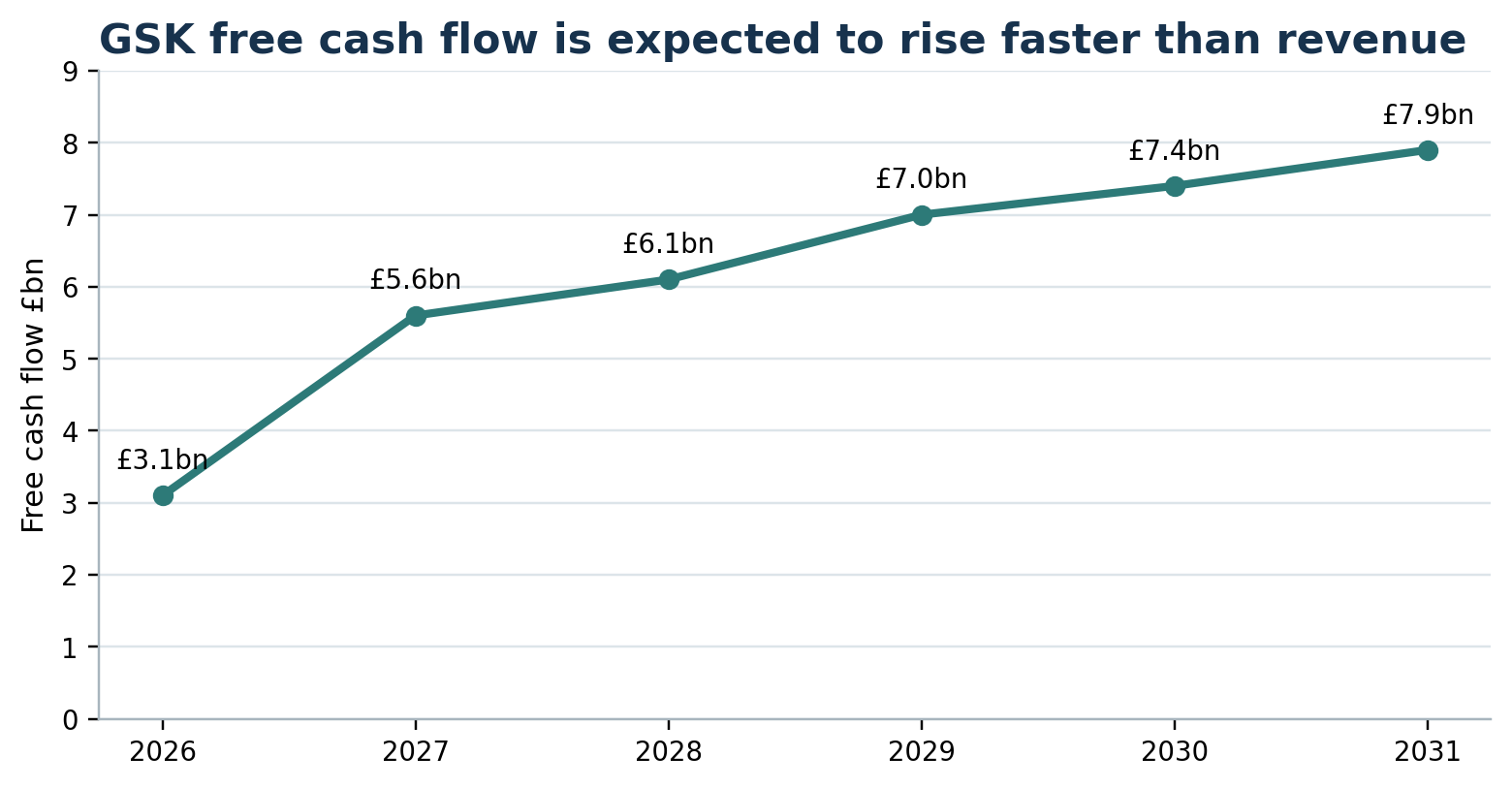
We can now turn the story into numbers. Analyst consensus estimates published by GSK in September 2026 provide an unusually useful starting point. Consensus expectations are approximately:
| Metric | 2026E | 2027E | 2028E | 2029E | 2030E | 2031E |
|---|---|---|---|---|---|---|
| Revenue £bn | 33.9 | 35.3 | 36.2 | 36.9 | 36.4 | 36.4 |
| Core operating profit £bn | 10.4 | 11.1 | 11.4 | 11.6 | 11.4 | 11.4 |
| Operating margin | 30.7% | 31.3% | 31.4% | 31.5% | 31.4% | 31.3% |
| EPS | 179p | 190p | 198p | 208p | 211p | 218p |
| Free cash flow £bn | 3.1 | 5.6 | 6.1 | 7.0 | 7.4 | 7.9 |
These figures are the consensus of brokerage analysts rather than GSK management forecasts. Look carefully at the revenue line. Sales rise from around £34 billion to only around £36 billion. That hardly looks like spectacular growth. But free cash flow is expected to rise much faster. This is important because companies are ultimately worth the cash that can eventually be returned to their owners, not simply their accounting revenue.
GSK's own definition of free cash flow represents cash available after items including capital expenditure, interest, tax and certain other obligations, which can ultimately fund shareholder distributions or strategic acquisitions. So now we can attempt a valuation.
Discounted Cash Flow
A discounted cash flow model asks a conceptually simple question:
What are all the future cash flows GSK is expected to produce worth today?
Future money is worth less than money received today. So each future cash flow must be "discounted" back to its present value. For this simplified equity DCF, I use the consensus free cash flow projections above and three major assumptions:
Cost of equity: 10.5%
This represents the return an investor might demand for accepting equity risk, pharmaceutical development risk, patent risk and execution uncertainty.
Long term growth rate: 1.5%
We cannot sensibly assume GSK grows at 5% forever. Eventually a mature pharmaceutical company should grow roughly alongside the wider economy over the very long term.
Forecast period: 2026 to 2031
After that, we estimate a terminal value representing cash flows extending beyond 2031. Using those assumptions produces approximately:
Present value of projected cash flows: £26 to 27 billion
Present value of terminal value: approximately £48 billion
Estimated equity value: approximately £74.5 billion
With roughly 4 billion shares outstanding, that equates to an illustrative value of around:
£18.55 per share
Compare that with GSK's market price of roughly £17.81 on 11 September 2026. The model therefore suggests that, under these assumptions, GSK trades fairly close to its estimated intrinsic value. But that is actually the least interesting conclusion. The more interesting conclusion is where that £74 billion comes from. A very large proportion of the valuation comes from cash flows occurring after our explicit forecast period.
That is exactly why small changes in expectations about future drugs can have enormous effects on pharmaceutical share prices. Investors are not merely paying for today's profits. They are paying for decades of assumed scientific and commercial productivity.
Change one assumption and billions disappear
DCF models can create a dangerous illusion of precision. £74.5 billion looks wonderfully exact. It isn't. Change the assumptions and the valuation changes substantially. For example:
| Scenario | Cost of equity | Long term growth | Approximate value |
|---|---|---|---|
| Bear case | 11.5% | 0.5% | £62bn |
| Base case | 10.5% | 1.5% | £74bn |
| Bull case | 9.5% | 2.5% | £94bn |
The same company can therefore be worth £62 billion or £94 billion without changing a single factory. What changed? Expectations. This is one of the most important lessons in valuation.
Market value is not a photograph of the company today. It is a collective prediction about the company tomorrow.
And pharmaceuticals magnify this effect because tomorrow is unusually uncertain.
The earnings multiple cross check
We can cross check the DCF using earnings multiples. GSK's consensus 2026 EPS is roughly 179p. At a share price of approximately £17.81, investors are paying roughly:
9.9 times expected 2026 earnings.
Using expected 2027 EPS of approximately 190p, the forward multiple drops to roughly:
9.4 times earnings.
That means an investor buying GSK today is effectively paying just under £10 for every £1 of forecast annual earnings. But a low P/E ratio is not automatically evidence that a company is cheap. Sometimes the market gives a company a low multiple because investors believe today's earnings will not last. That distinction is crucial in pharmaceuticals. A company earning £5 billion from drugs with fifteen years of patent protection deserves a different valuation from a company earning the same £5 billion from products whose patents expire next year.
Identical profits. Very different economic value.
Where GSKs market value comes from
We can now dissect the company more conceptually. Part of GSK's value comes from existing blockbuster products. Shingrix generated around £3.6 billion of sales in 2025. HIV remains a major franchise. Trelegy, Nucala, Benlysta, Jemperli and other medicines generate substantial existing revenues. These products provide the cash engine. But another part of the valuation comes from something investors cannot yet see on an income statement:
future medicines.
GSK had more than 60 clinical development assets by mid 2026 and expected more than 20 Phase III study starts during the year. This is where pharmaceutical valuation starts to resemble venture capital. Imagine GSK has an experimental medicine that could eventually generate £2 billion annually. You cannot simply add £2 billion of future sales to your valuation. The drug might fail Phase III.
Regulators might reject it. Competitors might develop something better. Doctors might not prescribe it. Payers might refuse the desired price. Manufacturing might prove difficult. The correct value is therefore probability adjusted. If a medicine could theoretically be worth £10 billion after approval but has only a 50% probability of successfully reaching the market, an investor might initially attribute something closer to £5 billion of risk adjusted value, before making further adjustments for timing, costs and competition.
Then a successful Phase III trial changes the probability. Perhaps the probability moves from 50% to 80%. Suddenly the same underlying molecule might be worth billions more without generating a single additional pound of current revenue. That is why pharmaceutical share prices can react so violently to clinical data.
The trial has changed the probability distribution of future cash flows.
Research and development as expense and investment
Traditional accounting creates another interesting problem. GSK is expected to spend roughly £7.2 billion on research and development in 2026, according to analyst consensus. On the income statement, R&D is an expense. Economically, however, part of that spending behaves more like investment. GSK is spending money today hoping to create intellectual property capable of generating cash flows for ten or twenty years.
Most experiments will never become blockbuster medicines. Some will fail entirely. But occasionally one succeeds spectacularly. This makes pharmaceutical R&D resemble a portfolio of risky investments. The company is essentially acting as an internal venture capital fund: fund one hundred scientific possibilities, accept that many fail, hope several become viable products, and rely on a handful of exceptional winners to generate returns on the entire portfolio.
The skill of management therefore matters enormously. Capital allocation in pharmaceuticals is not merely deciding whether to build another factory. It means deciding which scientific risks deserve another £500 million of shareholders' capital.
Acquisitions make the equation even more complicated
If internal laboratories cannot generate enough promising assets, pharmaceutical companies can buy them. GSK has increasingly used acquisitions and partnerships to strengthen its pipeline. This creates another valuation question: If a pharmaceutical company pays £5 billion for a biotech company whose leading medicine is not yet producing meaningful revenue, has £5 billion of value been created? Not necessarily. Value is created only if the future cash flows ultimately produced by the acquired assets exceed the price paid and the return shareholders could have earned elsewhere.
This distinction is easily forgotten during exciting biotechnology deals. A scientifically brilliant acquisition can still be a financially terrible acquisition. The medicine may work. The patients may benefit enormously. The acquisition may still destroy shareholder value if the buyer paid too much. Clinical value and financial value are related. They are not identical.
The role of the balance sheet
At the end of 2025 GSK carried approximately £14.5 billion of net debt, up from £13.1 billion the previous year. Analyst consensus currently expects net debt to be substantially higher in 2026 before declining over subsequent years as cash generation strengthens. Debt matters because enterprise value belongs to all providers of capital. Shareholders own what remains after financial obligations are considered.
This creates another discipline for management. Every pound used for acquisitions, dividends, R&D or share buybacks competes with every pound that could instead be used to reduce debt. In 2026, GSK completed a £2 billion share buyback programme, while continuing to invest heavily in R&D. Those are capital allocation decisions. And capital allocation is ultimately valuation in action.
The most important number in the model may not be revenue
Perhaps the most revealing line in GSK's forecasts is not total sales. It is the changing composition of those sales. Consensus estimates suggest Specialty Medicines could rise from around £15.1 billion in 2026 to £18.4 billion by 2031, while General Medicines decline from roughly £9.4 billion to £7.5 billion. Oncology alone is expected to expand from roughly £2.4 billion to more than £6.3 billion.
That is the transformation investors are really valuing. GSK does not necessarily need explosive overall revenue growth. It needs sufficiently valuable new products to replace declining old products while maintaining margins and cash generation. This is the pharmaceutical treadmill. Stop discovering and eventually the portfolio dies. Continue discovering but spend too much acquiring assets and shareholders may still lose. Cut R&D too aggressively and today's profit rises while tomorrow's pipeline disappears.
Spend recklessly on R&D and billions can disappear into failed experiments. Management must continuously balance science, probability, time and capital.
What GSK may be worth
My simplified base case model produces an equity valuation of approximately £74 billion, compared with a current market capitalisation around £72 billion. I would not interpret that as meaning "GSK is worth exactly £74 billion." The correct interpretation is more useful: At roughly today's market price, investors appear to be assuming that GSK can broadly deliver its expected cash flows, navigate major patent expiries and replace enough ageing products with its newer portfolio and pipeline.
If oncology, respiratory medicines, vaccines and next generation HIV products outperform expectations, today's valuation may prove conservative. If important pipeline assets fail, patent erosion arrives faster than expected or acquisitions fail to earn adequate returns, £72 billion could prove expensive. The valuation therefore represents a giant equation:
| Valuation driver | Effect on equity value |
|---|---|
| Existing medicines and remaining patent life | Provide the starting cash flows and determine how long they may last |
| Future prices volumes and pipeline assets | Determine the scale of potential replacement cash flows |
| Acquisitions and operating efficiency | Can add value when returns exceed their cost |
| Development failure patent erosion and competition | Reduce the duration or size of future cash flows |
| Debt | Reduces the value remaining for shareholders |
That is the anatomy of a pharmaceutical company.
What the valuation reveals
The most fascinating thing about valuing GSK is that the company's greatest assets do not sit neatly on a balance sheet. Its real assets are partly scientific. A molecule. A patent. A clinical dataset. A regulatory approval. A relationship with clinicians. A manufacturing capability competitors struggle to reproduce. A research team capable of finding the next molecule. And ultimately the confidence that when today's blockbuster disappears, another one will take its place.
That is why pharmaceutical valuation sits at such an interesting intersection between medicine, science and finance. A clinician may ask:
Does this medicine work?
A regulator may ask:
Is it sufficiently safe and effective?
A health system may ask:
Is it worth paying for?
And an investor asks a different question: After accounting for the probability of success, the time required, the money invested, competition and patent life, what are those future cash flows worth today? All four questions can produce different answers. And that may be the most important insight of all. A pharmaceutical company is not worth £72 billion because it possesses £72 billion of laboratories, tablets and vaccines.
It is worth £72 billion because investors collectively believe that the medicines it already owns, and the medicines it has not yet successfully created, will generate enough cash in the future to justify paying £72 billion today. In other words: A pharmaceutical company's valuation is ultimately a price placed on its ability to keep turning science into cash flow before yesterday's science runs out of time.
Figures are rounded. Valuation assumptions are illustrative and are intended to demonstrate financial modelling principles rather than constitute investment advice.