Key figures
| Figure | Why it matters |
|---|---|
| $14.6bn | Johnson and Johnson purchase price |
| 40% | Premium to the previous closing share price |
| $680.5m | Intra Cellular 2024 product sales |
| $5bn plus | Johnson and Johnson estimate of CAPLYTA peak annual sales potential |
| $1.9bn | Potential value created in the illustrative acquisition bridge |
Imagine proposing the following deal to an investment committee. The target is a pharmaceutical company worth about $10.5 billion on the stock market. It generated roughly $681 million of product sales in the previous year, remained loss making and would initially reduce the buyer's earnings per share. The proposed purchase price is $14.6 billion. At first sight, the obvious response is that the buyer is paying too much. Why hand shareholders about $4 billion more than the market valued their company the day before? Why pay more than 20 times recent product sales? Why accept lower earnings per share in the first years after the deal?
That is broadly what Johnson & Johnson agreed to do in January 2025 when it offered $132 per share in cash for Intra Cellular Therapies. The offer valued the company at approximately $14.6 billion and represented a premium of about 40% to its previous closing share price. The deal is useful because it exposes a basic principle of mergers and acquisitions: a company can have different values under different owners. The public market valued Intra Cellular as an independent biotechnology company. Johnson & Johnson valued the cash flows it believed it could generate after placing the same medicines inside its global commercial, regulatory and manufacturing system. The acquisition premium sits in the gap between those two views.
What Johnson and Johnson actually bought
Intra Cellular Therapies was a neuroscience focused biopharmaceutical company whose central asset was CAPLYTA, or lumateperone. Before the acquisition, CAPLYTA was already approved in the United States for schizophrenia and bipolar depression. Product sales rose from approximately $462 million in 2023 to $680.5 million in 2024, while prescriptions increased by about 41%. Johnson & Johnson was therefore buying an established and fast growing medicine, but the historical revenue was only the starting point. CAPLYTA had also been submitted to the US Food and Drug Administration for use as an adjunctive treatment in major depressive disorder, or MDD. Johnson & Johnson believed the product could eventually generate more than $5 billion in annual peak sales. The deal also included Intra Cellular's development pipeline, including ITI 1284 for conditions such as generalised anxiety disorder and Alzheimer's disease related psychosis and agitation.
The transaction can be summarised more clearly as a purchase of four connected assets: an existing commercial franchise, a potentially much larger new indication, additional pipeline programmes and the intellectual property supporting years of possible future cash flows.
| Transaction measure | Approximate amount |
|---|---|
| Previous equity market value | $10.4bn |
| Johnson & Johnson purchase price | $14.6bn |
| Premium paid above previous value | $4.2bn |
| Offer price per share | $132 |
| Premium to previous closing price | 40% |
| Intra Cellular 2024 product sales | $680.5m |
| Purchase price divided by 2024 sales | About 21 times |
Why a takeover premium is not automatically an overpayment
Suppose a house would sell for £1 million to an ordinary buyer. The owner of the neighbouring plot may be willing to pay more because combining both properties creates development opportunities that are unavailable to anybody else. The first house has not changed, but its economic usefulness has. The same logic can apply to a company. Intra Cellular's stand alone value depended on the cash flows it could generate with its own capital, workforce and infrastructure. Johnson & Johnson already had international regulatory teams, payer relationships, medical affairs staff, manufacturing capabilities, distribution networks and a large neuroscience business. Intra Cellular did not need to build all of those capabilities from the ground up; its medicines could be placed into an organisation that already possessed them.
This is the practical meaning of synergy. A synergy is not simply a pleasing description of strategic fit. It is a cash flow that the combined organisation may generate, or a cost it may avoid, that neither business could capture as effectively on its own. The value can come from faster international launches, lower duplicated corporate costs, better manufacturing economics, more efficient clinical development or stronger lifecycle management of the drug.
Historical sales can be the wrong denominator
Johnson & Johnson paid roughly $21 for every $1 of Intra Cellular's 2024 product sales. That multiple would look difficult to defend for a mature business with limited growth. It looks different if CAPLYTA develops as Johnson & Johnson expects.
| Year | Illustrative CAPLYTA sales |
|---|---|
| 2024 actual | $0.68bn |
| 2025 | $1.0bn |
| 2026 | $1.45bn |
| 2027 | $2.1bn |
| 2028 | $2.9bn |
| 2029 | $3.7bn |
| 2030 | $4.4bn |
| 2031 | $5.0bn |
| 2032 | $5.4bn |
| Mature peak | About $5.5bn to $6.0bn |
At $680 million of sales, the purchase price is about 21 times revenue. At $3 billion, it is about 4.9 times revenue. At $5 billion, it is about 2.9 times revenue. The price has not changed; the denominator has. This is why growth company acquisitions are rarely understood by looking only at the latest income statement. Buyers pay for the future cash flows they expect to own.
The early commercial evidence has supported part of that thesis. The acquisition closed on 2 April 2025, and in November 2025 the FDA approved CAPLYTA as an adjunctive treatment for adults with major depressive disorder. By the second quarter of 2026, Johnson & Johnson reported $361 million of quarterly CAPLYTA sales, an increase of approximately 71% year on year. Sales for the first six months of 2026 reached about $631 million. Simply annualising the second quarter figure gives a rough run rate of $1.44 billion, already more than twice Intra Cellular's full year 2024 product revenue.
That does not prove that the acquisition was a bargain. It does show why the 2024 sales multiple was an incomplete way to judge it.
From stand alone value to value under a new owner
A simple discounted cash flow model for CAPLYTA might assume that sales rise towards approximately $5.5 billion at maturity and that free cash flow margins gradually reach 30% to 32%. Pharmaceutical businesses can achieve operating leverage because revenue can grow faster than the cost of the infrastructure supporting it. Once the sales force, market access, manufacturing and regulatory systems are in place, the company does not necessarily need to increase every cost in proportion to each additional prescription.
Using an illustrative discount rate of 8.5% to 9% and allowing the franchise to mature before eventually declining, CAPLYTA's stand alone operating cash flows could have a present value of roughly $10 billion to $11 billion. That is close to Intra Cellular's approximate market value before the deal. The premium therefore needs to be supported by value that Johnson & Johnson could add beyond the stand alone case.
The relevant equation is straightforward:
Value to the buyer = stand alone value + synergies + pipeline value + strategic options minus integration costs minus financing costs minus execution risk.
If the total on the left exceeds the price paid, the acquisition may create value even though the buyer pays a substantial premium. If it does not, the premium becomes an overpayment.
How the premium can be shared
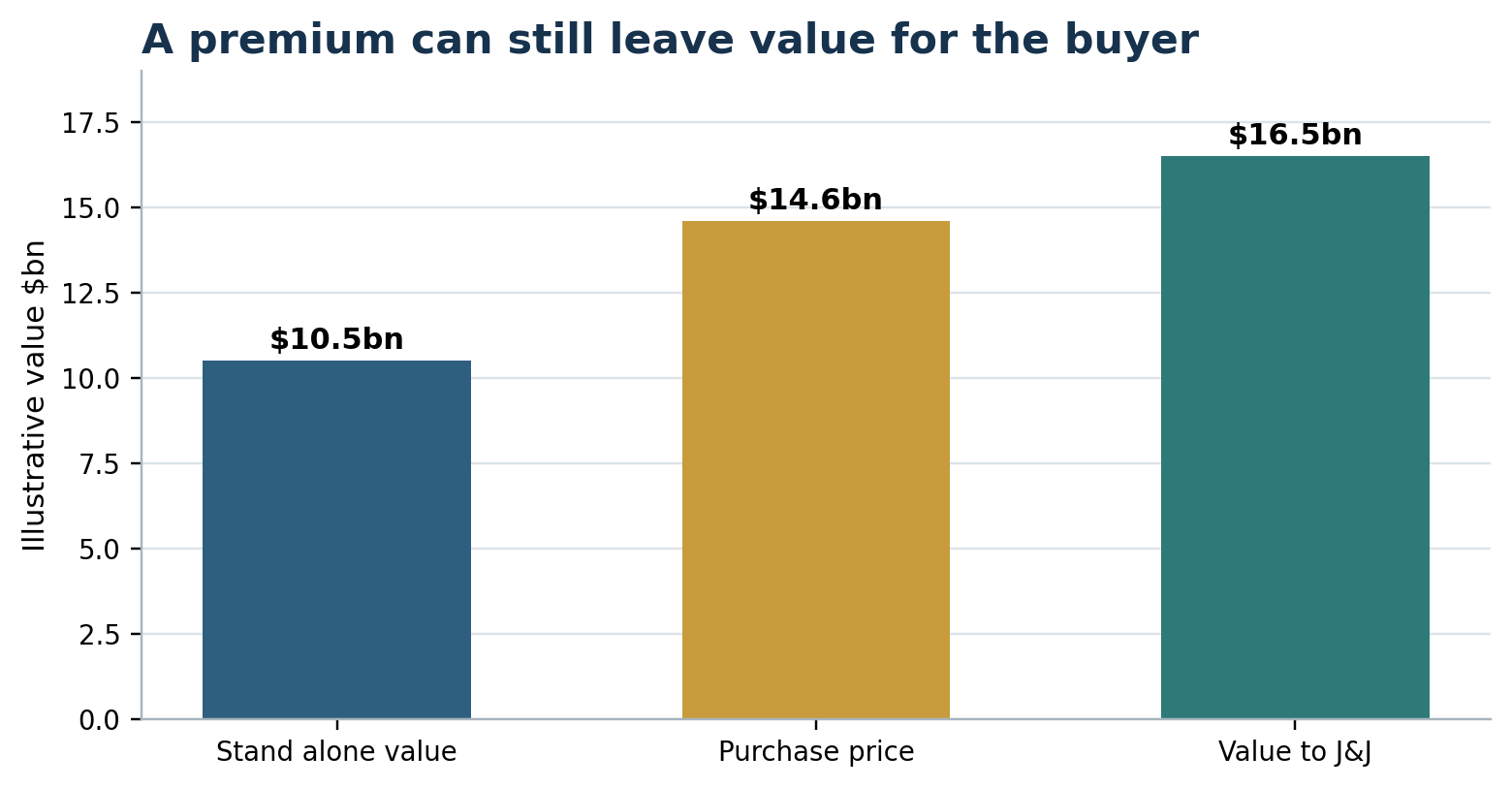
Assume, purely for illustration, that Intra Cellular is worth $10.5 billion independently and that Johnson & Johnson can create a further $7 billion through faster growth, cost savings, pipeline development and strategic fit. Under Johnson & Johnson's ownership, the business could then be worth $17.5 billion. Intra Cellular's shareholders would not normally agree to sell at the unaffected $10.5 billion value because they know the buyer expects to gain something from the transaction. At a purchase price of $14.6 billion, the sellers capture about $4.1 billion above the previous market value, while Johnson & Johnson retains approximately $2.9 billion of the hypothetical strategic value. Both sides can benefit.
This is what advisers are negotiating when they debate price. The seller's advisers use discounted cash flow, comparable companies, precedent transactions and premiums paid in earlier deals to support a higher valuation. The buyer's advisers test how much can be offered before the expected return becomes inadequate. Underneath the discussion about dollars per share lies a more important question: how should the future value created by the combination be divided?
| Illustrative value bridge | Value |
|---|---|
| Stand alone CAPLYTA cash flows | $10.5bn |
| Pipeline and additional indications | $2.0bn |
| Faster international expansion | $1.5bn |
| Cost and infrastructure synergies | $1.5bn |
| Other strategic options | $2.0bn |
| Gross strategic value | $17.5bn |
| Less integration and execution risk | ($1.0bn) |
| Estimated value to Johnson & Johnson | $16.5bn |
| Purchase price | ($14.6bn) |
| Potential value created | $1.9bn |
These figures are illustrative rather than Johnson & Johnson forecasts. Their purpose is to show the structure of the decision. The investment committee is not asking whether $132 exceeds the previous share price; that is obvious. It is asking whether the acquired business is worth more than $132 per share inside Johnson & Johnson.
What the acquisition accounting reveals
After an acquisition closes, the buyer allocates the purchase price across the assets and liabilities it has acquired. Johnson & Johnson's reporting associated the transaction with approximately $8.3 billion of acquired in process research and development, $5.2 billion of amortisable intangible assets and $2.9 billion of goodwill, alongside other assets and liabilities.
| Acquisition accounting item | Approximate value | What it broadly represents |
|---|---|---|
| In process research and development | $8.3bn | Programmes still being developed and their expected future value |
| Amortisable intangible assets | $5.2bn | Identifiable commercial rights and intellectual property consumed over time |
| Goodwill | $2.9bn | Remaining value linked to synergies, workforce and strategic fit |
These are not factories, warehouses or office buildings. Much of the purchase price relates to knowledge: a molecule, clinical evidence, regulatory progress, future indications, patents, commercial relationships and a scientific team. Goodwill is often described as proof that a buyer overpaid, but that is too simple. In accounting terms, goodwill is broadly the remaining amount after identifiable assets and liabilities have been measured at fair value. It can capture an assembled workforce, expected synergies and other value that cannot be separated into a specific patent or contract. It becomes important later because a material disappointment may require an impairment, an accounting acknowledgement that the original expectations were too optimistic.
Why lower earnings per share can still accompany value creation
Johnson & Johnson expected the acquisition to reduce adjusted earnings per share by about $0.25 in 2025 and $0.21 in 2026, with operating gains partly offsetting financing costs during 2026. The transaction was therefore expected to be EPS dilutive in the near term. Dilution does not automatically mean value destruction. If a buyer acquires a fast growing business whose largest cash flows arrive several years later, first year earnings per share may fall even when the present value of all future cash flows exceeds the purchase price. The reverse can also happen: cheap debt can make an acquisition immediately accretive to EPS even when the buyer has paid more than the acquired cash flows are worth.
The sounder test is economic rather than cosmetic: does the present value of the cash flows gained, after financing and integration costs, exceed the capital paid to acquire them?
Financing and the required return
Johnson & Johnson funded the deal with a combination of cash and debt. Both have an economic cost. Debt requires interest and changes balance sheet risk. Cash used for this acquisition cannot also fund another acquisition, internal research, manufacturing capacity, debt reduction, dividends or share repurchases. That forgone alternative is the opportunity cost of the transaction. If Johnson & Johnson requires an 8% return on $14.6 billion, the investment eventually needs to generate roughly $1.17 billion of annual economic return. At 10%, the figure is approximately $1.46 billion. This helps explain why the expectation of more than $5 billion in peak CAPLYTA sales matters. At a 30% free cash flow margin, $5 billion of revenue could produce about $1.5 billion of annual free cash flow. The real model is more detailed, but this calculation shows what management needs to believe.
| Required return | Approximate annual return on $14.6bn |
|---|---|
| 8% | $1.17bn |
| 10% | $1.46bn |
| Illustrative cash flow at $5bn sales and 30% margin | $1.50bn |
The strategic problem the deal helps solve
Large pharmaceutical companies must continually replace medicines approaching patent expiry. Johnson & Johnson has faced this issue with STELARA, whose sales have declined after biosimilar competition. In the first half of 2026, the company said STELARA's decline reduced worldwide Innovative Medicine operational growth by approximately 8.4 percentage points. CAPLYTA therefore matters not only as an asset in isolation but also as a potential new growth engine within Johnson & Johnson's portfolio. This is a recurring choice in pharmaceuticals: build innovation internally or buy it from companies that have already taken much of the early scientific risk. Internal research may be cheaper when it succeeds, but it is slow and uncertain. Acquisition is faster and more de risked, but the seller expects a premium.
Intra Cellular had already carried lumateperone through major clinical development, regulatory approval, commercial launch and substantial prescription growth. Johnson & Johnson bought after much of that risk had been removed. De risked assets are expensive because the buyer is paying for years of work and uncertainty that it no longer needs to bear.
What could make the acquisition fail
The deal becomes difficult to defend if CAPLYTA sales plateau far below expectations, adoption in major depressive disorder disappoints, pricing deteriorates, patent protection is weaker than assumed, competitors introduce better treatments, pipeline assets fail or the expected commercial and cost benefits do not materialise. This is why the word synergy deserves scrutiny. Cost savings can often be linked to specific duplicated functions and implementation plans. Revenue synergies are less certain. A claim that a global platform will accelerate growth needs to be translated into countries, patients, launch dates, prices, costs and probabilities. Without that detail, synergy can become a convenient label for the value required to make a high purchase price look reasonable.
Whether Johnson and Johnson overpaid
It is too early to know. A transaction completed in 2025 and built around cash flows expected well into the next decade cannot be judged from one year's earnings. The evidence so far is encouraging: quarterly CAPLYTA sales reached $361 million in the second quarter of 2026, the product received the important MDD approval and Johnson & Johnson continues to target more than $5 billion in peak annual sales.
If the franchise reaches that scale and Johnson & Johnson captures meaningful benefits from international expansion, infrastructure and further development, $14.6 billion may prove reasonable. If CAPLYTA materially underperforms, the 40% premium will be harder to justify. The central lesson is that the premium tells us how much more Johnson & Johnson paid than the previous market price. It does not tell us how much more the asset could be worth under Johnson & Johnson's ownership. Different buyers have different capital, capabilities, tax positions, commercial networks and strategic needs. Those differences change future cash flows, and different cash flows produce different valuations.
That is the connection between medicine and corporate finance. Scientists ask whether a drug works. Clinicians ask whether it improves patients' lives. Commercial teams estimate how many patients may receive it. Payers decide what healthcare systems will reimburse. Lawyers assess how long the intellectual property can be protected. The investment banker brings those answers into a financial model and asks how much the buyer can pay without giving away all of the value.
The best question is therefore not why Johnson & Johnson paid $14.6 billion for a company previously valued at about $10 billion. It is whether Johnson & Johnson can turn that company into an asset worth materially more than $14.6 billion. If it can, the premium was the price of acquiring the future before somebody else did.
Financial Anatomy Part IV. Historical company and transaction figures are based on public company disclosures. Forecasts, cash flow assumptions, synergy estimates and valuation bridges are illustrative models for educational analysis and do not represent Johnson & Johnson management forecasts or investment advice.