Key figures
| Figure | Why it matters |
|---|---|
| $12bn | Approximate recent equity market value |
| $958m | Rezdiffra sales in 2025 |
| $364m | Second quarter 2026 revenue |
| 49,000+ | Patients receiving Rezdiffra by June 2026 |
| $11bn to $13bn | Illustrative base case equity value |
There is a peculiar moment in the life of a biotechnology company when it stops being valued primarily on hope but is not yet mature enough to be valued primarily on earnings.
Madrigal Pharmaceuticals sits almost exactly at that point.
Until recently, Madrigal was largely a development stage biotechnology company built around an experimental treatment for a liver disease that, despite affecting millions of people, had no approved drug therapy. Then everything changed. In March 2024, the US Food and Drug Administration approved Rezdiffra (resmetirom) for adults with MASH, metabolic dysfunction associated steatohepatitis, with moderate to advanced fibrosis. The commercial response was striking.
Madrigal generated just $180 million of product revenue in 2024, the year Rezdiffra launched. In 2025, sales increased to approximately $958 million. By the second quarter of 2026, quarterly sales had reached $364 million, up 71% year on year, while more than 49,000 patients were receiving the drug. Trailing twelve month Rezdiffra revenue was already approaching $1.3 billion. Yet Madrigal was recently valued by the stock market at roughly $12 billion.
That creates a fascinating investment question:
How does a company selling roughly $1.3 to $1.5 billion of medicine justify a valuation approaching ten times that amount?
The answer takes us into one of the most interesting areas of financial modelling: valuing an emerging pharmaceutical company before its economics have fully matured. And unlike GSK, where dozens of products diversify the risk, Madrigal forces us to confront the question much more directly:
How much is one drug really worth?
A simple company with a difficult valuation
At first glance, Madrigal is unusually easy to understand. One disease. One dominant commercial product. One therapeutic area. And a pipeline being constructed around that existing franchise. That simplicity is appealing. But from an investment perspective it also creates concentration risk. If Pfizer has a disappointing quarter in one product line, another franchise may compensate. If a company such as Madrigal suffers a major commercial or clinical setback in its principal asset, the effect on its valuation can be enormous.
The investment thesis therefore depends heavily on four questions:
How large can Rezdiffra become?
How long can Madrigal protect those economics?
How much competition will arrive?
And perhaps most importantly:
Can Madrigal turn one successful drug into an enduring pharmaceutical franchise rather than remaining a one product company?
Those four questions are effectively the financial model.
Start with the patient not the income statement
One of the most useful ways to model a pharmaceutical company is to work backwards from patients. Madrigal estimated that its addressable US F2 F3 MASH market had increased from approximately 315,000 patients at the end of 2023 to around 460,000 by the end of 2025. Yet only around 10% of MASH patients are currently diagnosed, and treatment penetration also remains around 10%.
That is important. Because the bullish argument for Madrigal is not merely that Rezdiffra can steal market share from competing medicines. It is that the market itself may become much larger. MASH is one of those unusual therapeutic areas where pharmaceutical competition could actually expand the commercial opportunity. More medicines mean more physician awareness. More awareness produces more screening. More screening produces more diagnoses.
More diagnosed patients become potential candidates for treatment. This creates a very different dynamic from entering an established market where every new entrant simply divides an existing pool of patients. In MASH, competitors may partly compete for the same patients while simultaneously helping create new patients for the treated market. That distinction matters enormously.
Forty nine thousand patients may only be the beginning
Madrigal reported more than 49,000 Rezdiffra patients by June 2026, passing 50,000 shortly afterwards. Compare that with approximately 460,000 diagnosed F2 F3 patients in its current US target market. Madrigal has therefore penetrated only roughly one tenth of that existing opportunity. And there is another potential market sitting behind it. Rezdiffra is currently being studied in patients with well compensated MASH cirrhosis, or F4c.
Madrigal estimates that approximately 245,000 US F4c patients are already diagnosed and under specialist care. Its pivotal outcomes trial is expected to report in 2027. If successful and approved, management believes the indication could approximately double Rezdiffra's addressable opportunity. Suddenly the mathematics becomes interesting. Today:
approximately 50,000 treated patients.
Potential existing F2 F3 specialist market:
approximately 460,000 patients.
Additional F4c opportunity:
approximately 245,000 patients.
And this is before assuming continued growth in diagnosis rates. An investor is therefore not paying $12 billion for 50,000 patients. They are paying for some probability that today's 50,000 eventually becomes 100,000, 150,000, 200,000 or considerably more. That distinction is the heart of the valuation.
Build the revenue model
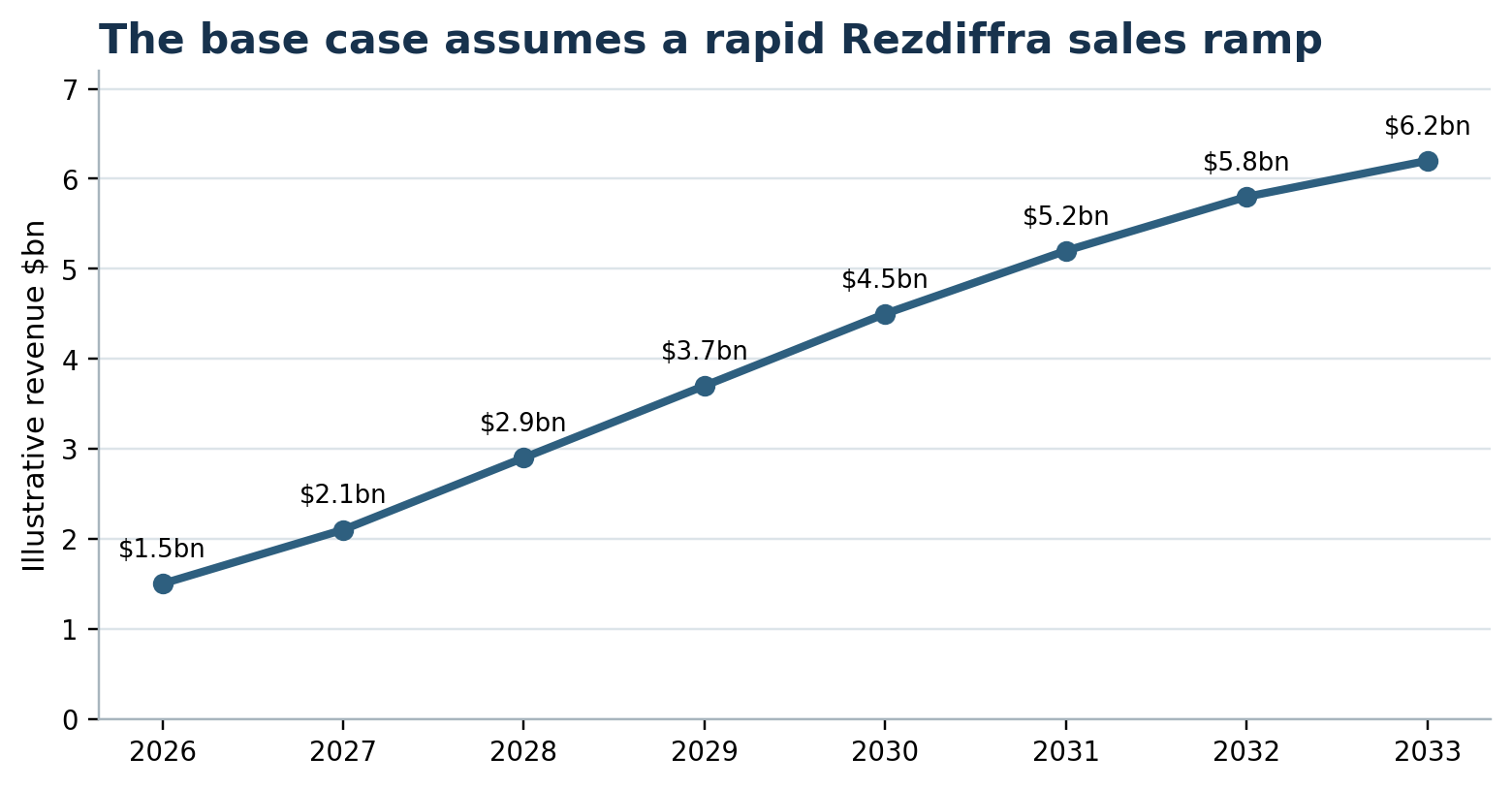
The second quarter 2026 revenue figure gives us a useful starting point. Rezdiffra generated approximately:
$364 million in Q2 2026
Annualised, that is roughly:
$1.46 billion
Madrigal's trailing twelve month number was already close to $1.3 billion. Now imagine a simplified revenue trajectory. This is my illustrative model rather than company guidance:
| Year | Illustrative Rezdiffra revenue |
|---|---|
| 2026E | $1.5bn |
| 2027E | $2.1bn |
| 2028E | $2.9bn |
| 2029E | $3.7bn |
| 2030E | $4.5bn |
| 2031E | $5.2bn |
| 2032E | $5.8bn |
| 2033E | $6.2bn |
| Mature peak | About $6.5bn to $7.0bn |
That looks aggressive. But consider what it actually implies. At around $30,000 of net annual revenue per treated patient, $5 billion of annual revenue would broadly equate to around 165,000 patient equivalents. That would still represent well below half of today's 460,000 person US F2 F3 target population, before considering growth in diagnosis, Europe or a possible F4c indication.
So the bull case does not require Rezdiffra to treat every eligible patient. It requires Madrigal to establish Rezdiffra as a foundational therapy in a market that grows substantially around it. That is a much more credible proposition. But it is by no means guaranteed.
What the current income statement does not show
This is where emerging pharma companies can look strange financially. During Q2 2026, Madrigal generated $364 million of revenue. Cost of sales was only around $40 million. That implies a product level gross margin approaching 90%. But Madrigal also spent approximately:
$289 million on selling, general and administrative expenses
and
$91 million on research and development.
The result was a quarterly net loss of approximately $58 million. A quick reading of those figures might suggest:
Revenue: $364 million. Profit: negative. Therefore the company is expensive.
But that misses what is happening economically. Madrigal is building a commercial infrastructure around a drug whose revenues are expanding rapidly. Some of those costs will increase as the company grows. Others should not increase proportionally with every additional prescription. This creates operating leverage. If revenue eventually reaches $5 billion, Madrigal should not need to multiply its corporate headquarters, sales force and administrative costs by the same amount.
A far greater proportion of each additional dollar of revenue can therefore fall through towards operating profit and cash flow. This is why investors can rationally value an unprofitable pharmaceutical company highly. They are not valuing today's margin. They are valuing the potential mature margin structure.
A simplified Discounted Cash Flow valuation
This requires a different DCF from the one we used for GSK. For a mature diversified business, using a terminal value can be reasonable. For a company whose economics depend heavily on patented intellectual property, blindly assuming cash flows grow forever is dangerous. Patents expire. Competition arrives. Drug franchises decay. So I would explicitly model Rezdiffra's cash flows through its principal patent protection period rather than pretending its economics continue indefinitely.
Madrigal says recently issued Rezdiffra patents should provide US protection into approximately 2045 for elements of its current F2 F3 dosing regime, while an F4c patent is expected to extend into 2042. My base case therefore assumes:
Revenue rises towards approximately $6.5 to $7 billion at maturity.
Free cash flow margins gradually rise towards the low to mid 30% range as commercial scale develops.
Revenue eventually declines as competition intensifies and intellectual property protection approaches expiry.
Discount rate: approximately 10.5%.
Discounting those illustrative operating cash flows back to today produces approximately:
$10.4 billion
of present value from the core Rezdiffra franchise in my model. Madrigal reported approximately $839 million of cash and investments at June 2026 and had a $350 million initial senior secured term loan outstanding under its financing facility, leaving a meaningful net cash position before other balance sheet adjustments. Add some value for the emerging pipeline and future strategic optionality, and the result begins to approach:
$12 to 13 billion.
That is remarkably close to the company's recent market valuation. And that tells us something important.
Madrigal does not look obviously cheap simply because Rezdiffra is growing quickly
The current market capitalisation already assumes considerable commercial success. The real investment question is whether reality can become better than the success already embedded in the share price.
Scenario analysis
A single point DCF is rarely useful in biotech. Probability matters too much. So instead consider three possible Madrigals.
Bear case
Rezdiffra adoption slows. GLP 1s and competing MASH therapies become more formidable. F4c disappoints. Peak revenue reaches only approximately $4 billion. Margins remain lower because commercial spending remains high. Using a higher 12.5% discount rate, my simplified model produces an equity value in the region of:
$4 to 6 billion.
That would represent substantial downside from today's valuation.
Base case
Rezdiffra retains a strong position. Diagnosis continues increasing. F2 F3 penetration steadily improves. International markets contribute. Revenue ultimately reaches approximately $6.5 to $7 billion. The company eventually develops strong pharmaceutical margins. My approximate equity valuation becomes:
$11 to 13 billion.
In other words, reasonably close to where the market already values Madrigal.
Bull case
Now imagine something more interesting. Rezdiffra establishes itself as the backbone of MASH therapy. The F4c study succeeds. Combination therapy becomes important. Diagnosis expands considerably. Madrigal captures international markets. Its additional pipeline produces useful complementary assets. Peak franchise sales approach $9 to 10 billion. At that point my model can support an equity valuation comfortably above:
$20 billion.
The bull case therefore potentially produces very meaningful upside. But importantly, investors do not receive that upside for free. They must accept genuine clinical, commercial and competitive risk.
The market is really pricing probabilities
This is why biotechnology investing is so fascinating. Suppose investors believe successful F4c expansion could ultimately create another $5 billion of present value. Before the clinical trial result, perhaps the market attributes only a 60% probability to success. Risk adjusted value:
$5bn × 60% = $3bn.
Then positive Phase III results arrive. Perhaps investors move their probability from 60% to 90%. The risk adjusted value becomes:
$5bn × 90% = $4.5bn.
The company has not suddenly generated another $1.5 billion of cash. No new prescription has necessarily been written. But approximately $1.5 billion of theoretical valuation has appeared because uncertainty has fallen. That is why biotech share prices can move violently after clinical readouts.
Clinical trials are financial events because they change probabilities.
How GLP 1 medicines could change the market
Any serious investment case for Madrigal has to confront obesity medicines. MASH frequently exists alongside obesity, type 2 diabetes and wider metabolic disease. GLP 1 medicines have transformed the treatment of obesity and metabolic disease and may increasingly affect MASH treatment pathways. It is tempting to frame this simply as:
GLP 1 versus Rezdiffra.
But Madrigal itself appears to be betting on a more complicated future. In 2025 the company licensed an oral GLP 1 candidate, MGL 2086, and by June 2026 had begun Phase I dosing. Its strategy is eventually to study an oral GLP 1 in combination with Rezdiffra, based partly on evidence that weight loss may enhance Rezdiffra's antifibrotic effectiveness. That tells us something strategically important.
Madrigal is not assuming that one mechanism will own the entire disease. It is preparing for a future in which MASH resembles oncology or inflammatory disease: multiple mechanisms, different patient phenotypes, combination treatment, and increasingly personalised regimens. If that is correct, Rezdiffra's value may not lie in being the only drug used in MASH. Its value may lie in becoming the foundational drug around which other therapies are added.
That could be even more strategically valuable.
The acquisition question
Now imagine you are sitting in the healthcare investment banking division of a major bank. A large pharmaceutical client asks:
Should we buy Madrigal?
The answer cannot simply be:
Rezdiffra is growing quickly.
The banker must ask a completely different set of questions. What are Rezdiffra's probability adjusted lifetime cash flows? What percentage of those cash flows is already reflected in Madrigal's $12 billion valuation? What premium would shareholders demand? Could the acquirer remove duplicated corporate costs? Could its existing global commercial infrastructure accelerate European and Asian adoption? Could it develop Madrigal's pipeline faster?
Could it finance the acquisition more cheaply? Would the transaction be accretive to earnings? And critically:
Would buying Madrigal create more value than developing or licensing competing assets internally?
That is the corporate finance question.
A hypothetical 16 billion dollar offer
Consider a hypothetical transaction. Madrigal is worth approximately $12 billion in the public market. A large pharmaceutical company offers:
$16 billion.
Shareholders receive roughly a 30% premium. But the acquirer now has a problem. It cannot simply demonstrate that Rezdiffra is worth $16 billion. It needs to show that Rezdiffra is worth more than $16 billion to that particular buyer. Perhaps the standalone value is $12 billion. But imagine a large pharma company can generate: $2 billion of value from faster international expansion;
$1.5 billion from commercial and administrative synergies; $2 billion from more efficient pipeline development; and another $3 billion from combination opportunities with products it already owns. Suddenly the asset may be worth $20 billion inside the acquirer. Paying $16 billion could therefore create $4 billion of strategic value. That is why the same company can rationally be worth different amounts to different owners.
And it is one of the most important principles in M&A:
Price and value are not the same thing
Why Madrigal is not an obvious private equity target
This is where the answer becomes slightly counterintuitive. Madrigal is fascinating for investors. It is fascinating for healthcare bankers. It could potentially be fascinating for strategic pharmaceutical buyers. But it is not an obvious traditional leveraged buyout candidate. Why? Private equity traditionally likes businesses with: predictable cash flows, relatively stable earnings, debt capacity, and reasonably foreseeable exit values. Madrigal currently has substantial product concentration, continued operating losses, large R&D requirements and major clinical event risk.
Those characteristics limit how much conventional acquisition debt can sensibly be placed on the company. The investment thesis is driven more by growth, intellectual property and scientific optionality than by financial leverage. So Madrigal looks more naturally suited to strategic pharma M&A, public market healthcare investors, crossover funds and specialist life science capital than to the classic debt heavy LBO model. That distinction itself tells us something about valuation.
Not every attractive business is attractive to every form of capital.
One drug can be simultaneously an asset and a risk
There is another paradox. Rezdiffra is Madrigal's greatest strength. It is also Madrigal's greatest weakness. The extraordinary launch creates enormous operating leverage. But concentration means that the company's fortunes remain disproportionately connected to one molecule. That changes how investors should think about valuation. A diversified pharma company might deserve a lower discount rate because cash flows are spread across numerous assets.
Madrigal arguably deserves a higher one. Its future depends on fewer variables. That is why merely comparing Madrigal's price to sales ratio with a large pharmaceutical company is almost meaningless. A dollar of GSK revenue and a dollar of Madrigal revenue are not economically identical. Madrigal's dollar may be growing dramatically faster. But it carries substantially greater concentration risk. Valuation is the attempt to price both simultaneously.
Research and development as a strategic choice
Madrigal generated nearly $1 billion of revenue in 2025. Yet rather than simply harvesting Rezdiffra's cash flows, management is investing heavily to build a wider MASH portfolio. The company now has more than ten development programmes, including four clinical stage programmes, and is pursuing combination strategies around Rezdiffra. This creates one of the hardest capital allocation questions in biotechnology. Should management maximise the profitability of the product that already works?
Or should it sacrifice current earnings to create the next generation of products? Cut R&D heavily and the income statement looks better. But the company risks becoming an ageing one drug franchise. Spend aggressively and current profitability looks worse. But the probability of creating a durable MASH platform potentially rises. So once again:
Accounting profit and economic value are not necessarily the same thing.
What would make me change the model
For an investor, this may be more useful than the price target itself. There are several numbers I would monitor relentlessly. First is patient growth. Revenue can be affected by inventory and pricing. Patient numbers tell us whether real adoption continues. Second is diagnosis growth. If the addressable MASH population continues expanding, the ceiling on Rezdiffra's opportunity rises. Third is F4c clinical data in 2027.
That could materially enlarge the franchise, or remove a meaningful component of the bull case. Fourth is competitive data. A superior competing therapy could force us to reduce both Rezdiffra penetration and pricing assumptions. Fifth is operating leverage. At some point revenue growth needs to translate into cash generation. If SG&A continues rising nearly as rapidly as sales indefinitely, the mature margin assumptions in our model are wrong.
And finally there is the pipeline. If Madrigal can create a second meaningful drug, the investment proposition changes fundamentally. It would no longer be:
How much is Rezdiffra worth?
It would become:
How much is the Madrigal MASH platform worth?
Those are very different companies.
What the current valuation assumes
That is not actually the most interesting question. At roughly $12 billion, I would argue the market is already giving Madrigal substantial credit. Investors appear to be pricing in continued Rezdiffra adoption, significant market growth and the emergence of attractive mature margins. That means the investment case cannot simply be:
Rezdiffra is a blockbuster.
The market already knows that. The investment case must instead be:
Rezdiffra will become a considerably larger franchise than the market currently assumes, or Madrigal will create additional valuable assets around it.
That distinction separates company analysis from valuation. A great company is not necessarily a great investment at every price. And a rapidly growing drug is not automatically an undervalued drug.
What the valuation reveals
GSK and Madrigal illustrate two completely different versions of pharmaceutical finance. GSK is a portfolio. Its valuation depends partly on whether dozens of existing and future medicines can collectively replace products approaching maturity. Madrigal is closer to a concentrated bet. Its valuation depends heavily on the probability that one extraordinary commercial launch develops into an entire therapeutic franchise. And that brings us to perhaps the most interesting lesson from the exercise.
When investors look at Madrigal's roughly $12 billion market capitalisation, they are not really valuing the company that exists today. Today, Madrigal has around 50,000 patients on its principal drug, remains loss making and is still building its commercial infrastructure. What investors are valuing is a future Madrigal. A company treating perhaps hundreds of thousands of patients. A company generating several billion dollars of annual sales.
A company with pharmaceutical scale operating margins. A company whose drug potentially expands into cirrhosis. Perhaps a company with multiple MASH therapies. Possibly even a company that no longer exists independently because a larger pharmaceutical group has decided those future cash flows are worth more inside its own portfolio. That is what the $12 billion represents. Not today's earnings. Not today's balance sheet.
Not today's patient numbers. It represents the present price of a possible future. And that is why emerging pharmaceutical companies are among the most fascinating businesses to value. With a mature company, valuation often asks:
How long can these cash flows continue?
With an emerging pharmaceutical company, the question is almost the reverse:
How large could these cash flows become before the rest of the market realises it?
And somewhere between those two questions lies the difference between paying $12 billion for an expensive biotechnology company and paying $12 billion for the early stages of a pharmaceutical franchise that may eventually be worth considerably more. Financial figures are rounded. The forecasts, DCF assumptions and bear/base/bull valuations above are my illustrative modelling assumptions for educational analysis and are not Madrigal management guidance or investment advice.