Watch or read
An expanded narrated adaptation with family illustrations, animated Nordic flags and practical employer examples. Approximately eight minutes. AI narration.
In this article, I reflect on six years raising a family, followed by six years studying medicine and becoming an NHS doctor. I explore the barriers parents face when returning to paid employment, what employers and government could do to help, and why I now support others with their next steps.
For six years, I was a stay-at-home parent raising a young family and was not in paid employment. Written on a CV, that period can be compressed into two words: career break. It looks almost like an absence, as though professional life stopped and very little happened in between.
But life certainly did not stop.
Those years were filled with the practical realities of raising children: organising competing schedules, managing a household, making constant decisions, stretching finances, solving problems, responding when plans changed unexpectedly and carrying the mental load that comes with responsibility for other people.
None of it came with a job title, salary or performance review. There was no promotion at the end of a particularly difficult year and no certificate recording the capabilities developed along the way.
Yet when parents later attempt to return to paid employment, those years are often discussed primarily in terms of what they have lost.
How long have you been away from the workplace? Is your experience still current? Will you be able to adjust? Why is there such a large gap on your CV?
There is considerably less discussion about what may have been gained.
And that matters, because returning to work after several years at home is not simply an administrative exercise involving a CV and a few applications. For many people, particularly women who have taken longer periods away from employment, it can involve rebuilding an entire professional identity.
The person who once moved confidently through work can begin to feel surprisingly distant after several years outside it. Former colleagues progress. Industries evolve. Technology changes. Other people accumulate promotions, qualifications and experience while your own life becomes organised around school runs, appointments, childcare and the relentless logistics involved in keeping a family functioning.
Slowly, a different set of questions can begin to emerge.
What am I qualified to do now? Would anyone employ me after this long? Have I fallen too far behind? What would I even apply for? Where do I start?
I understand those questions because I had to confront versions of them myself.
After six years at home, I eventually made the decision to return to education and study medicine. That decision was the beginning of another six-year journey. I went back to university, completed medical school and eventually graduated as a doctor, going on to work in the NHS.
From the outside, that journey can be reduced to its outcome: medical degree, graduation, doctor.
But the reality was far more complicated.
Returning to education after years away required rebuilding confidence, adapting again to formal learning, managing the demands of an intensive degree and doing all of that while continuing to raise a family. There were practical questions about childcare and time, but there were also quieter questions about identity and belonging.
Could I still do this? Had I been away too long? Was it realistic to begin something so demanding at that stage of my life?
That experience fundamentally changed the way I think about people trying to return to education or employment after a prolonged period away.
I know what it means to look at the next stage of your life and not yet be able to see clearly how you will get there.
But I also know what can happen when somebody is given the opportunity, information and support to begin.
A career break can interrupt a trajectory.
It does not erase the person who built it.

The problem is not simply confidence. The numbers have to work.
Even when somebody decides they are ready to return, there is another obstacle that is much less philosophical: childcare.
For many parents, the decision to return to employment begins with a calculation.
What is the salary? How much is nursery? How much is breakfast club? What will after-school care cost? What happens during school holidays? How much does commuting add? Who collects the children if work finishes after childcare closes? What happens when a child is ill?
A job can look perfectly viable when viewed as an annual salary and far less viable when viewed through the economics of a household.
For some parents, returning to work means that a substantial proportion of their income immediately disappears into childcare and transport. For others, the difficulty is not even the financial cost. It is the incompatibility between the working day and the school day.
A school might finish in the middle of the afternoon. A conventional job does not.
Holiday entitlement rarely matches school holidays.
Children become ill without reference to rota schedules, deadlines or meetings.
For families without grandparents, partners with flexible working arrangements or other support nearby, these are not minor inconveniences. They can determine whether employment is possible at all.
We often describe employment as an individual decision.
For parents, it is frequently an ecosystem.
And if the surrounding infrastructure does not work, the person cannot simply compensate by becoming more motivated.
The cost does not stop with the parent
There is also a wider economic argument.
When capable people remain outside the workforce for longer than they would otherwise choose because childcare is unaffordable, working structures are inflexible or they cannot find a credible route back into employment, the economy loses productive capacity.
The most visible loss is income.
But the effects go much further.
Career progression slows. Pension contributions are reduced. Professional skills may become less current. Lifetime earnings can be affected long after children have become independent.
Some people eventually return to employment significantly below their previous level because the role that best fits their capabilities does not offer the flexibility their family requires.
Others never return to the sector in which they originally trained.
Employers lose experience. Government loses potential tax revenue. Industries complaining of talent shortages overlook skilled people who are already available but unable to find a workable route back in.
There is also another category of loss that is much harder to measure.
The business never started.
The promotion never pursued.
The qualification never undertaken.
The idea never explored.
The leadership role somebody no longer believed they were capable of pursuing.
These losses rarely appear neatly in economic statistics, but they represent human capital that exists without being fully used.
We talk frequently about productivity, workforce shortages and the need to develop talent.
Perhaps we should spend more time asking how much talent already exists but is being left on the sidelines.
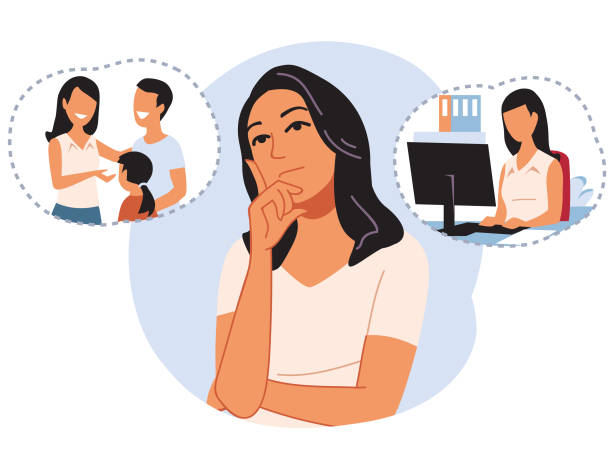
Employers could do much more than simply say they support parents
If organisations genuinely want experienced parents to return, flexibility has to exist in the design of work rather than simply in statements about culture.
Recruitment is one place to begin.
A CV gap should not automatically be treated as a warning sign. Hiring managers can be trained to distinguish between a genuine competency gap and a period outside formal employment. Job descriptions can also be more realistic about which requirements are essential and which are merely inherited from previous recruitment rounds.
Organisations could create structured returnship programmes offering a defined period of paid work, refresher training, mentoring and a genuine route into permanent employment. For somebody who has been outside the workplace for several years, that bridge can be far less intimidating than being expected to compete immediately with candidates whose careers have been uninterrupted.
Employers could also provide skills-refresh programmes before or immediately after somebody joins. Technology can change significantly in a few years. Giving somebody the opportunity to update those skills is far more sensible than discarding years of previous experience because one part of their knowledge needs refreshing.
Flexible working also needs to mean more than allowing somebody to work from home occasionally.
For a parent, meaningful flexibility might involve predictable rotas, sensible start and finish times, compressed hours, genuine part-time career pathways, job sharing or the ability to adjust working arrangements as children move through different stages.
Predictability matters almost as much as flexibility. It is extremely difficult to organise childcare around a schedule that changes constantly.
There is also a cultural issue.
Flexible workers should not quietly be removed from promotion opportunities because they cannot remain in the office late into the evening or because they work four days rather than five. A system in which people are technically allowed flexibility but penalised professionally for using it is not genuinely flexible.
Senior leaders and managers also need to recognise that somebody returning from a career break may need a period of adjustment without this being interpreted as lack of ambition or capability.
The aim should not be to lower standards.
It should be to remove barriers that have little relationship to someone's ability to meet them.

Government also has a role
There are limits to what individual employers can solve.
Childcare infrastructure is ultimately a public policy issue as well as a family one.
If governments want higher workforce participation among parents, childcare has to be treated partly as economic infrastructure.
We readily understand that transport allows people to reach jobs and that digital infrastructure allows businesses to operate. Reliable and affordable childcare performs a similar economic function for millions of parents.
Policy therefore needs to look beyond childcare for very young children and consider the full working life of a family: breakfast provision, after-school care, school holidays and the difficult transition points when formal childcare reduces but children are still far too young to be left alone.
Financial support also needs to be designed so that returning to work genuinely leaves families better off. Parents should not reach a point where an additional day at work produces relatively little additional household income once childcare, transport and other costs are accounted for.
Government could also expand targeted retraining and return-to-work programmes for people who have spent several years caring for children or relatives. That might include subsidised professional refresher courses, digital skills training, careers guidance, sector-specific return programmes and partnerships with employers willing to recruit returners.
Universities and further education providers have a role too. Returning to education can be one of the most powerful routes back into professional life, but mature students often face very different constraints from people entering education directly from school.
I know that personally.
When I returned to university to study medicine, I was not simply a student.
I was a student and a parent.
Those identities existed simultaneously, and any serious attempt to widen access to education needs to understand that reality.
Better coordination between employment, education and childcare policy could make an enormous difference to people who currently fall between all three systems.

This is why helping other parents became important to me
My own experiences eventually shaped something else.
I started helping other people navigate their return.
It did not begin with a formal organisation or a grand plan. It began with a conversation with a friend who wanted advice about what she could do next.
We talked through her options.
What had she done before?
What skills did she have?
What might fit around her circumstances?
Where could she obtain the information she needed?
That led to another conversation, and then another.
I began to realise how many capable people were asking variations of the same question:
“I have been out of work for years. Where do I even start?”
What struck me was that they were rarely lacking intelligence or ambition.
What they often lacked was confidence, information, direction and somebody who could help them turn an enormous question — What do I do with my life now? — into a smaller and more manageable one:
What is my next step?
That experience eventually developed into a peer-support group. I now work one-to-one with people who are considering returning to education, employment or changing direction altogether.
Sometimes I help somebody think through career options. Sometimes we talk about transferable skills and how to present their previous experience. Sometimes I help them identify training or educational opportunities. Often, my role is simply to signpost them towards reliable information and resources that they did not know existed.
I do not believe helping somebody means deciding their future for them.
Often it means helping them regain enough clarity and confidence to begin deciding it for themselves.
That matters because long periods outside employment can gradually make people feel that their choices have narrowed.
Childcare dictates one thing.
Finances dictate another.
School hours dictate something else.
Before long, ambition becomes something postponed until circumstances are more convenient.
But life rarely becomes perfectly convenient.
Sometimes people need help identifying what is possible within the life they actually have.
We need to stop treating nonlinear careers as failed linear ones
My own path has reinforced something I now believe very strongly.
Professional lives are rarely as tidy as CVs make them appear.
People have children. They care for relatives. They become ill. They move countries. They retrain. They return to university. They start businesses. They change industries. They discover ambitions later than expected.
My own journey took me from six years at home raising a family, to six years studying medicine, to graduating and working as a doctor in the NHS.
It was not the most conventional route.
But unconventional does not mean unsuccessful.
And that is why I find the idea of parents “starting again” so misleading.
We are not blank pieces of paper simply because our employment histories contain gaps.
We carry everything that came before with us: previous education, work experience, judgement, maturity, resilience, mistakes, responsibilities, relationships and the skills developed through years of managing lives that may never have appeared on a job description.
Of course, some professional knowledge may need refreshing.
That is normal.
But needing to update a skill is not the same as having nothing left to offer.
Perhaps employers should therefore ask fewer questions about why somebody has a gap and more questions about what they are capable of doing next.
And perhaps policy makers should stop treating childcare and career re-entry simply as private family problems when they have such obvious consequences for labour participation, productivity and economic growth.
When I look back at the six years I spent at home with my family now, I no longer see an empty space between two professional chapters.
I see part of the story.
Those years shaped the person who eventually walked into medical school. They shaped the doctor I became. They shaped the way I think about opportunity, resilience and the assumptions we make about people whose lives have not followed conventional trajectories.
And they are one of the reasons I feel so strongly about helping other parents navigate what comes next.
Because the person sitting at home wondering whether they still have something to offer may need new skills.
They may need affordable childcare.
They may need flexible employment.
They may need retraining, information, encouragement or simply somebody willing to help them work out the next step.
But they do not need to erase everything that came before and begin again.
Parents are not restarting from zero.
They are restarting from experience.
great article, i was wondering if you could also include how other european countries e.g like the nordic countries and any other countries in other continents, how they manage to do a good job with navigating this very important issue
Yes. Adding an international comparison strengthens the article because it shows that the difficulties parents face are not inevitable. Other countries have made different policy choices about childcare, parental leave and flexible work, and some provide useful lessons for the UK.
I would not turn it into a policy report, though. The international examples should remain part of the narrative. I would insert the following after the section on what government can do.
We already know that different choices are possible
None of these problems is unique to the UK, and no country has solved them completely. But looking elsewhere is useful because it demonstrates that the relationship between parenthood and employment is shaped not only by individual choices, but by the systems surrounding those choices.
The Nordic countries are perhaps the clearest example.
What is striking about countries such as Sweden, Denmark, Norway and Finland is not simply that they spend more generously on families. It is that support is designed much more like a continuum. Parents are supported when a child is born, childcare becomes available as parental leave ends, and the expectation that both parents should be able to participate in working life is built into the system.
In Sweden, for example, parents have access to 480 days of parental benefit for one child, with most of those days linked to previous income. The important principle behind systems like this is that caring for a child is not treated as something that belongs exclusively to women or as an interruption that families must somehow absorb privately. Nordic family policy has increasingly been designed around a dual-earner, dual-carer model, with portions of parental leave reserved for each parent.
Then there is childcare.
In Denmark, children with legal residence are guaranteed access to an age-appropriate childcare place from shortly after six months of age until they begin school. Finland guarantees early childhood education and daycare from around nine months to school age, with low fees and no charge for some low-income families.
Norway has gone even further on affordability. From August 2025, the national maximum parental fee for kindergarten was reduced to NOK 1,200 per month, with still lower charges in some less central areas and additional support for low-income families. More than 94% of children aged one to five were attending kindergarten in 2024.
These are individual policies, but together they illustrate something more important.
Childcare is being treated as infrastructure.
We readily accept that an economy needs roads, trains, broadband and energy in order for people to work productively. Childcare performs a similarly enabling function. A parent cannot participate fully in the labour market if there is nowhere safe and affordable for their child to be while they work.
Recent OECD analysis describes the Nordic countries as having comprehensive, publicly supported childcare systems that make it easier for both parents to participate in paid employment. Formal childcare use for very young children is correspondingly high across much of the region.
That does not mean that the Nordic model is perfect. Women still experience pay and progression gaps, parents still make career compromises, and different groups do not benefit equally from every policy. But the underlying philosophy is important: parenthood is treated as a predictable part of working life, rather than an exceptional event that individual families — and usually individual women — must solve alone.
That distinction matters.
Beyond Europe, other countries are experimenting too
There are useful lessons outside Europe as well.
Canada, for example, has spent recent years building a nationwide early-learning and childcare system aimed at dramatically reducing the amount parents pay. By 2024, more than half of Canadian provinces and territories had reached average regulated childcare fees of CAD $10 a day or less, while the remaining jurisdictions had reduced average parent fees by at least 50%.
Again, the interesting point is not simply the headline price.
Reducing the cost of childcare changes the calculation a parent makes when deciding whether an additional day of employment is worthwhile. If earning an extra £100 effectively costs almost £100 in additional childcare, transport and associated costs, the financial incentive to work becomes extraordinarily weak. Lowering childcare costs changes that equation.
Japan offers another interesting lesson, this time about the workplace itself.
Since October 2025, Japanese employers have been required to provide employees raising children between the ages of three and school entry with a choice of flexible-working measures. Employers must offer at least two options from a menu that can include altered start times, remote working, additional leave, shorter working hours or workplace childcare support.
The approach is interesting because it recognises something that is often forgotten in discussions about parental employment: the childcare problem does not disappear when a child turns three.
Parents still have school runs. Children still become ill. Schools still finish before conventional working days do. School holidays still bear little resemblance to annual leave allowances.
Supporting parents therefore cannot end with maternity leave and nursery provision. The structure of work itself also matters.
What should the UK learn from this?
I do not think the answer is simply to copy Sweden, Norway, Canada or Japan.
Countries have different tax systems, labour markets, demographics and social expectations. Policies also involve trade-offs, and even the countries that perform relatively well continue to struggle with inequalities between men and women.
But there are principles worth borrowing.
The first is continuity.
Support should not consist of isolated interventions — maternity leave at one stage, childcare assistance at another, flexible-working legislation somewhere else. Parents experience these things as one continuous journey. Policy should be designed in the same way.
The second is affordability.
Childcare cannot meaningfully support employment if the cost of accessing it absorbs much of the additional income that work generates.
The third is availability.
A childcare subsidy is of limited value if there is no childcare place available, if the hours do not match the working day or if provision collapses during school holidays.
The fourth is shared responsibility.
Policies that enable and encourage fathers as well as mothers to take parental leave matter because the consequences of having children should not automatically become concentrated on women's careers.
And the fifth is flexibility without professional punishment.
Parents should not have to choose between using the flexibility they need and being regarded as less committed, less promotable or less ambitious.
Taken together, these lessons suggest something important.
Perhaps we have framed this debate incorrectly.
We frequently ask:
How do we help mothers return to work?
Perhaps the better question is:
How do we design work, childcare and public policy so that becoming a parent does not require somebody to leave the economic mainstream in the first place?
That is a much more ambitious question.
But it may also be the right one.
The economic case is as important as the social one
There is a temptation to discuss policies supporting parents entirely through the language of fairness and family wellbeing.
Those things matter enormously.
But there is also a hard economic argument.
The OECD has repeatedly linked accessible childcare with women's ability to participate in paid employment, and its work on the Nordic economies has found that rising female employment made a substantial contribution to long-run economic growth.
Conversely, long career interruptions have financial consequences that can persist for decades. OECD modelling shows that childcare-related employment breaks can reduce eventual pension entitlements, although the effect varies considerably depending on how individual countries compensate people for time spent caring for children.
This is why I think the debate should move beyond the idea that supporting parents is simply a benefit provided to individual families.
It is an investment in productive capacity.
If somebody who is educated, experienced and willing to work remains outside employment because childcare costs more than they can reasonably afford, that is not only a problem for that parent.
It represents unused human capital.
If somebody returns after six years and can only secure work substantially beneath their capabilities because employers cannot see beyond the gap in their CV, that too represents unused human capital.
And if somebody who might eventually become a doctor, engineer, entrepreneur, teacher, executive or business owner concludes that the route back is simply too difficult, we may never know what has been lost.
That last point is particularly personal to me.
I spent six years at home raising my family.
I then made the decision to return to education and embarked on another six-year journey through medical school. I eventually graduated as a doctor and went on to work in the NHS.
There was nothing inevitable about that outcome.
Had I looked at those years at home and concluded that I had been away too long, that I was too far behind, or that beginning again was unrealistic, my life could have taken an entirely different direction.
And that is partly why I care so much about the parents I now speak to one-to-one.
When someone tells me that they have been at home for five, six or ten years and do not know what they could possibly do next, I understand the uncertainty behind that question.
I also know that their present circumstances are not necessarily a reliable measure of their future potential.
Sometimes the difference is information.
Sometimes it is childcare.
Sometimes it is education or retraining.
Sometimes it is an employer willing to look beyond an unconventional CV.
And sometimes it is simply having another person help you break an intimidating transition into smaller, achievable steps.
That is what began for me with one conversation with a friend and gradually grew into supporting more parents through one-to-one conversations, career guidance and signposting to relevant information and opportunities.
The more people I speak to, the more convinced I become that we should stop viewing this population primarily in terms of what they lack.
We should start asking what would happen if we made it easier for them to use what they already possess.
Because behind the phrase career break can sit years of previous education, professional experience, entrepreneurship, judgement, resilience, responsibility and potential.
The Nordic countries, Canada and others have not discovered a perfect solution. What they demonstrate is something simpler but perhaps more important:
systems can be designed differently.
A society can decide that childcare is infrastructure.
An employer can decide that flexibility and ambition are compatible.
A government can decide that helping somebody remain economically active is an investment rather than merely a cost.
And an individual can discover that six years away from employment did not erase everything that came before.
That is ultimately why I return to the same idea.
Parents are not restarting from zero.
They are restarting from experience.